
Owners of recreational vehicles increasingly rely on plug-in solar panels to keep essentials powered during trips. The following selected products blend efficiency, portability, and durability to help RV travelers extend time off-grid without sacrificing comfort. This guide highlights five standout options, from rugged roof-mounted kits to compact foldables, with practical notes on performance, installation, and durability for RV use.
| Product | Key Feature | Ideal For |
|---|---|---|
| ECO-WORTHY 200W Kit | High-efficiency mono cells, corrosion-resistant frame, 30A PWM controller | Full RV power setup with solid daily output |
| Renogy 200W Portable Foldable | 25% efficiency, lightweight foldable design, USB-C/USB-A outputs | Compact power on the go, easy to stash in RV |
| Renogy Adventurer 200W Kit | 30A PWM controller, durable frame, wide application | Balanced roof or vehicle mounting with durable performance |
| Renogy 200W ShadowFlux Panel | ShadowFlux anti-shading tech, 25% efficiency, compact | Shaded roof areas or urban RV use |
| 23.5% efficiency, IP67 waterproof, multiple output options | Supplemental power for smaller RV setups |
ECO-WORTHY 200 Watts 12/24V Solar Panel Kit

The ECO-WORTHY kit combines a high-efficiency monocrystalline panel with a 30A PWM charge controller designed for RVs, campers, and off-grid vehicles. It targets daily outputs around 800Wh under favorable sun, suitable for running lights, small appliances, and battery charging. The panel features a corrosion-resistant aluminum frame built to resist strong wind and snow loads, with an IP65 junction box for protection. This setup supports both 12V and 24V systems, offering a practical, all-in-one solution for RV installations that need consistent daytime power without frequent adjustments.
Renogy 200W Portable Solar Panel, IP65 Foldable

Renogy’s 200W foldable solar panel emphasizes portability, weighing about 13.89 lbs with a compact fold-down size. It uses upgraded 16BB N-Type cells for up to 25% efficiency, enabling faster energy generation in limited spaces. The kit is ideal for charging power stations and 12V batteries, and its E.Flex folding design makes it suitable for RVs, SUVs, and on-the-go camping. A built-in USB-C PD and USB-A outputs provide convenient charging for devices directly from the panel, complementing a larger RV solar array or serving as a backup when solar space is tight.
Renogy 200W Monocrystalline RV Kit with Adventurer 30A LCD PWM
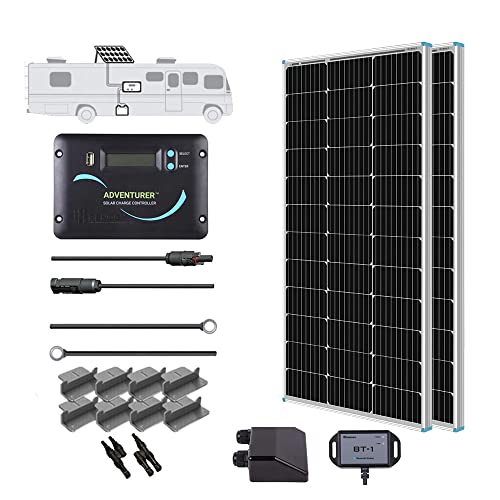
This Renogy Adventurer kit is designed for RV, boat, and off-grid use, pairing a 200W monocrystalline panel with a 30A LCD PWM charge controller. The kit’s 800Wh daily output estimate fits well for compact RVs needing a steady power source while maintaining a smaller footprint. The corrosion-resistant aluminum frame ensures resilience against outdoor conditions, and the system can withstand high winds and snow loads. The Adventurer controller supports convenient monitoring and protection features, helping users manage charging and battery health with ease.
Renogy 200W ShadowFlux Anti-Shading Panel

Renogy’s ShadowFlux 200W panel features anti-shading technology and 25% cell efficiency with an N-Type configuration. The panel’s design prioritizes reduced hot spots and micro-cracks, delivering more reliable performance in partially shaded RV rooftops or urban sites with tree cover. It’s compact and lightweight for easy roof installation or portable use, and the same robust frame machinery used in larger systems ensures long-term durability for RV adventures that encounter variable weather.
ZOUPW 100W Portable Solar Panel

The ZOUPW 100W portable panel focuses on compact solar power for RVs requiring supplemental energy. It boasts 23.5% efficiency with ETFE coating for durability and IP67 waterproofing. The kit includes various output options, such as USB-C and traditional USB-A ports, and it’s built to withstand camping, RV trips, and emergencies. While smaller than full roof kits, it provides practical daytime charging for power stations, phones, tablets, and essential devices when minimal roof real estate or temporary setups are required.
Buying Guide: Key Purchase Considerations
- Power needs and space: Determine daily energy consumption and available roof space or storage to choose between a full kit, portable panel, or modular system. Higher daily output helps in running multiple devices, but may require a larger panel or array.
- Panel type and efficiency: Monocrystalline panels offer higher efficiency and space savings, ideal for RV roofs. N-Type cells can push efficiency higher, while PERC technology improves light capture. Consider slight trade-offs with weight and cost.
- Durability and weather resistance: Look for corrosion-resistant frames, IP ratings, and robust junction boxes. RV sites may expose panels to wind, rain, and snow, so a rugged build extends lifespan.
- Charge controller compatibility: PWM controllers are common and cost-effective, but MPPT controllers can optimize charging under variable conditions; ensure compatibility with your battery bank (12V or 24V) and solar panel output.
- Portability vs. permanence: Foldable or portable panels are ideal for RVs with limited roof space or for temporary setups. Fixed roof kits provide steady, integrated power for long trips.
- Connector standards and expansion: Check MC4 compatibility and options to add more panels later. Some kits include USB outputs for direct device charging, which is convenient for on-the-go use.
- Warranty and support: Choose brands that offer solid warranties and accessible support, especially for off-grid travelers who rely on continuous power.
- Installation considerations: For roof-mounted systems, ensure structural integrity and proper sealing to prevent leaks. For portable panels, secure mounting and stability during movement are essential.
Across these options, the best fit depends on your RV size, typical travel routes, and how much daily energy you expect to harvest from sunlight. For full-time RV living or extended trips, an integrated roof system with a reliable charge controller is often preferable. For weekenders or travelers with minimal roof space, a high-efficiency portable panel can provide substantial supplementary power without a permanent installation.