
The purpose of a paint depth gauge is to reveal hidden repainting, repairs, or inconsistencies in a vehicle’s coating. This guide shows top options ideal for used-car buyers, detailers, and automotive inspectors. Each entry explains who it’s best for, why it was selected, and a practical caveat. Use the brief comparison table to compare core capabilities at a glance.
Selected products at a glance
- RDINSCOS Car Coating Thickness Meter — Best for used-car buyers who want steel and aluminum handling in one tool.
- VVV-Group CM-205FN — Best for quick, factory-calibrated readings with automatic substrate detection.
- VVV-Group CM-224 Auto — Best for professionals needing automatic Fe/NFe/Fe+Zn detection and clear LCD readouts.
- VVV-Group CM-224Pro — Best for detailed professional inspections with auto-calibration and multi-substrate detection.
- Mcbazel Paint Thickness Tester — Best for field use with a magnetic tip and battery-free operation.
RDINSCOS Coating Thickness Meter For Used Cars
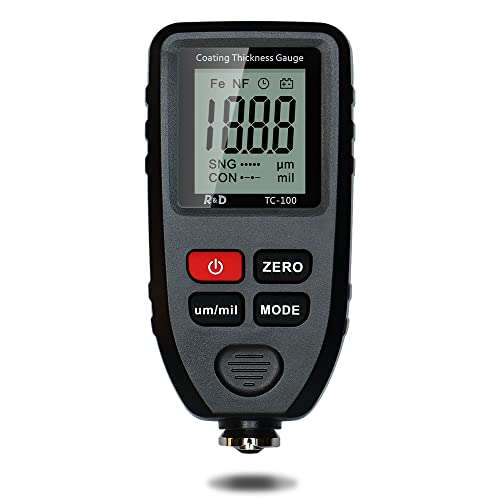
Key features include auto-detection for steel and aluminum coatings, enabling accurate measurements across ferrous and non-ferrous substrates. This makes it especially useful for automotive paint inspection, powder coating checks, and metal surface finishing on items like used cars, anodized aluminum, bathroom fittings, bike frames, and more. The tool is designed for metallic surfaces only. It helps buyers spot hidden repairs by measuring coating thickness on each panel, reducing the risk of purchasing a vehicle with undisclosed repainting. Best for: used-car buyers who want a straightforward, substrate-aware reading across common automotive materials.
Caution: Not ideal for non-metallic surfaces. Ensure you are measuring relevant metallic panels to avoid misleading results.
VVV-Group CM-205FN Coating Thickness Meter

Best for professionals seeking high accuracy with 0.1 μm resolution and ±3%+2 μm accuracy. It automatically detects Fe (steel) and NFe (aluminum) substrates, simplifying use across modern cars with mixed body materials. This model is factory calibrated and ready to use, with a large backlit LCD for clear readings. It’s well-suited for pre-purchase checks, dealership inspections, and mobile appraisers who need quick, repeatable measurements. Caution: May require familiarity with coating notation to interpret Zn-containing readings correctly in galvanized areas.
VVV-Group CM-224 Auto – Digital Coating Thickness Meter

Best for automotive inspectors who need a ready-to-use device with automatic Fe/NFe detection and a 0.1 μm resolution. The CM-224 Auto supports Fe (steel), NFe (aluminum), and Fe+Zn (galvanized) substrates, facilitating accurate evaluation of mixed-material panels. It ships factory calibrated and features a large backlit LCD for easy viewing in various lighting conditions. Choose this if you frequently compare coatings across different body parts like doors, hoods, and roofs. Caution: The Zn detection may require careful interpretation alongside other panel history data.
VVV-Group CM-224Pro – Pro Auto Coating Thickness Meter
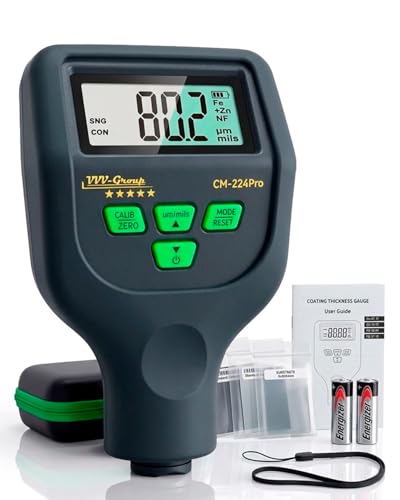
Best for structured professional evaluation of vehicle panels. The CM-224Pro offers Fe/NFe/Zn auto-detection with auto calibration, enabling precise comparisons between factory coatings and refinished surfaces. It supports a wide range (0–59.1 mils / 0–1500 μm) with 0.01 mils (0.1 μm) resolution. This model is suited for dealerships, inspections, and professionals needing detailed thickness profiles across multiple panels such as doors, hoods, and roofs. Caution: Higher complexity may require more training compared to basic models.
Mcbazel Paint Thickness Tester Meter

Best for on-site inspections with a magnetic tip and no batteries required. This tester provides quick, magnetic-based readings to detect prior repairs or repainting on a variety of car surfaces. It uses a color-coded scale for easy interpretation and is designed for outdoor use where power sources are limited. Choose this if you need a simple, rugged tool for immediate checks on dirty or wet surfaces. Limitation: Magnetic-based readings may be less precise on certain complex panels compared to electronic gauges.
Abizarch Fe/NFe Coating Thickness Gauge HW-300PRO

Best for those who need recording and data management inside a compact device. This model can record average, maximum, and minimum values, supports up to 50 data points, and offers automatic power-down to save battery life. It measures across metal coatings and other coatings (paint/enamel/chrome) on steel and aluminum, with automatic substrate detection. It emphasizes data organization for thorough vehicle inspections. Caution: The feature set may be more advanced than needed for casual buyers, potentially increasing complexity.
Kakalote Digital Paint Thickness Gauge

Best for general automotive inspections with 0–2000 μm range and 1 μm resolution. It offers automatic substrate detection, including FE and NFE measurements, and alerts with a large backlit LCD. The device is designed for car-body checks across different materials and coatings. Practical for buyers who want a versatile gauge that covers a wide thickness range. Caution: Battery requirements are typical; batteries are not included, so plan accordingly for field use.
Reenwee Paint Thickness Gauge

Best for quick checks with automatic calibration and data hold. It supports two units (mm and mil) and focuses on non-destructive measurement of car paint thickness. This is suitable for both professionals and hobbyists who need straightforward readings without setup. Limitation: Limited detail on substrate types may require cross-checks with other methods for complex panels.
Buying Guide: Key Purchase Considerations
- Substrate detection: Do you need automatic Fe/NFe or Zn detection for steel, aluminum, and galvanized surfaces?
- Resolution and range: Is 0.1 μm resolution and a 0–1500 μm range sufficient for your inspection needs?
- Calibration: Factory-calibrated vs. manual calibration — how much setup complexity fits your workflow?
- Readability: Do you prefer a large backlit LCD and easy-to-read displays for varying lighting conditions?
- Data collection: Is data storage or record-keeping important for your inspections or appraisals?
- Portability: Do you need a compact, battery-free, or rugged handheld design for field use?
FAQs
- What is a paint depth gauge used for? It measures coating thickness to identify repainting or repairs on vehicle panels.
- Which gauge automatically detects substrate type? Several models, including CM-205FN, CM-224 Auto, and CM-224Pro, offer automatic Fe/NFe/Zn detection.
- Do I need to calibrate before use? Some models are factory calibrated and ready to use; others may require simple calibration steps.
- Is a higher resolution better? Yes, higher resolution (0.1 μm) provides more precise readings, especially for detecting subtle thickness differences.
- Can these devices detect non-metallic coatings? Most are designed for metallic substrates; check product specs for suitability with non-metal surfaces.
- Are battery-free options available? Yes, some models use magnetic tips or other battery-free mechanisms for field use.