
Answering the question, “What oil is best for my snow blower?” this guide highlights reliable 4-cycle engine oils that help maximize cold-weather performance and engine longevity. The selected products are suitable for common snow blowers and include synthetic and mineral formulas. This overview helps buyers identify oil types based on climate, engine design, and maintenance preferences.
| Product | Best For | Notes |
|---|---|---|
| Briggs & Stratton 100030C 5W30 Engine Oil | Briggs & Stratton engines and OEM compatibility enthusiasts | Genuine Briggs & Stratton parts; designed to OEM standards |
| STP Premium Small Engine 4 Cycle Oil SAE 10W-30 | All-season use in small engines | Synthetic blend; good for year-round starts |
| Husqvarna XP+ 2 Stroke Oil | Husqvarna tools and bulk replacement needs | 2-stroke oil; note: for 2-stroke configurations |
| MTD 4-Cycle Snow Thrower Oil | Most snow throwers with 4-cycle air-cooled engines | Specially formulated for snow throwers |
| TRIAX Power 4-Stroke SAE 30W | High wear protection and long life in small engines | High-zinc formula; broad all-season performance |
The following sections profile five top options in detail. Each product includes a buyer-oriented note on who it’s best for, plus practical cautions when relevant. This article aims to help you pick the right oil without guessing, using clear, comparison-friendly language.
Briggs & Stratton 100030C 5W30 Engine Oil

Best for Briggs & Stratton engines and users wanting OEM-compatible maintenance. This 5W30 engine oil is formulated to meet Briggs & Stratton standards, aiding peak performance in compatible four-stroke engines. It is designed to fit Briggs & Stratton equipment and helps ensure compliance with applicable EPA emission regulations when used as part of the OEM maintenance routine. Choose this if you own Briggs & Stratton equipment and prefer genuine parts for reliability. Caution: This product is engine-oil specific to Briggs & Stratton engines; verify compatibility with your model before use.
STP Premium Small Engine 4 Cycle Oil SAE 10W-30

Best for all-season small engines, including snow blowers, lawnmowers, and generators. The STP Premium 10W-30 is a synthetic blend designed to promote easier starts in various climates and seasons. It offers antioxidants to resist thermal breakdown, helping maintain oil effectiveness under heat. This makes it a solid choice for year-round maintenance where multiple small engines share oil. Limitation: As a 4-cycle oil, ensure your engine requires 10W-30 type before use.
Husqvarna XP+ 2 Stroke Oil

Best for Husqvarna equipment users in need of bulk replacement oil. This is a genuine Husqvarna replacement part, packaged for bulk use. It’s suitable for 2-stroke applications where a proper 2-stroke mix is required. If your snow blower or other equipment uses a 2-stroke design, this oil supports proper lubrication. Caution: Confirm your engine type; this is a 2-stroke oil, not suitable for most 4-stroke snow blowers.
MTD 4-Cycle Snow Thrower Oil

Best for snow throwers with 4-cycle air-cooled engines. Made for snow-thrower applications, this oil is formulated to withstand cold-starts and high-load winter operation. It aligns with common engine configurations from brands like Troy-Bilt, MTD, Yard Machines, and similar lines. Choose this if your snow blower is an MTD or compatible 4-cycle model. Limitation: It is tailored for snow thrower engines; verify your model’s requirements before use.
TRIAX Power 4-Stroke SAE 30W
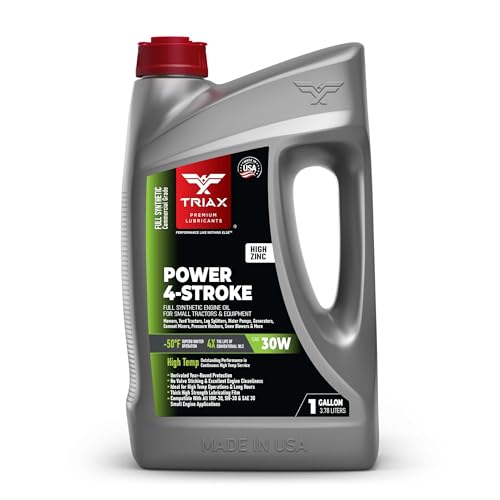
Best for high-wear protection and long engine life in small engines, including snow blowers. TRIAX Power 4-Stroke SAE 30W features a high-zinc formula, delivering enhanced wear protection for four-stroke small engines. It’s designed for extreme shear resistance and thermal stability, potentially extending engine life under heavy use. Use this if you need robust protection under demanding winter conditions. Caution: A 30W rating is thicker than some winter formulas; ensure compatibility with your engine’s specified viscosity.
Buying Guide: Key Considerations For Snow Blower Oil
- Engine type: Most snow blowers use 4-stroke or 2-stroke engines. Confirm your model’s requirements (2-stroke oils are not suitable for 4-stroke engines).
- Viscosity and temperature: In cold climates, lower winter grades like 5W-30 or 0W-30 help with cold starts. Thicker grades like 30W provide protection at higher temperatures but may be harder to start in extreme cold.
- Synthetic vs mineral: Synthetic or synthetic-blend oils offer better high-temperature stability and longer intervals between changes. Mineral oils are often more economical and sufficient for mild climates.
- OEM compatibility: Some brands recommend OEM-spec oils for warranty and performance. Using genuine parts or recommended formulations can help meet emission and performance standards.
- Oil change frequency: Follow your operator’s manual for intervals, but consider more frequent changes in severe winter use or high-load conditions.
- Storage and handling: Store oil in a cool, dry place and seal tightly to prevent moisture ingress, which can degrade viscosity and performance over time.
Frequently Asked Questions
- What oil should I use for a snow blower with a 4-cycle engine? Choose a 4-cycle engine oil with the viscosity recommended in your manual, typically 5W-30 or 10W-30 for cold climates.
- Is there a difference between 2-stroke and 4-stroke snow blower oil? Yes. 2-stroke oils are mixed with fuel, while 4-stroke oils stay in the crankcase. Do not mix them unless the engine design specifies otherwise.
- Can I use a regular automotive oil in a snow blower? Not always. Snow blowers often require smaller engines with specific viscosities; check your manual before using automotive oil.
- How often should I change snow blower oil? Typically after the first 5-10 hours of run time, then per the manufacturer’s guidelines or at least once per season under normal use.
- Is synthetic oil better for winter use? Generally yes, synthetic oils perform better in very cold starts and maintain viscosity across temperature ranges, though consider cost and OEM recommendations.
- Should I use the same oil for all my small engines? Not necessarily. While some small engines share common requirements, verify oil type and viscosity per engine model and manufacturer recommendations.