
Answering the core buying need: a clamp meter that measures current without interrupting circuits, while also testing voltage, resistance, and continuity. This guide highlights five reliable options suitable for different users—pros needing rugged professional tools, DIYers tackling home projects, and technicians who require precise readings and convenient features. Each product includes who it’s best for and why it’s a strong pick. A quick comparison table helps you scan key capabilities at a glance.
| Product | Best For | Key Strengths | Limitations |
|---|---|---|---|
| Klein Tools CL120 Digital Clamp Meter | Professional electricians and techs needing NCVT and auto-ranging | Auto-ranging, NCVT, backlit display | Limited current range for some heavy-duty tasks |
| AstroAI Digital Clamp Meter 2000 Counts | Budget-conscious DIYers and home projects | AC/DC voltage, current, data features, included batteries | DC current testing not supported |
| KAIWEETS Digital Clamp Meter | Electricians and hobbyists needing wide range and NCV | TRUE-RMS, D-shaped jaw, NCV, temperature | May be more complex for beginners |
| Fluke 302+ Digital Clamp Meter | Techniques requiring rugged accuracy with high current | 400 A capacity, wide voltage range, solid accuracy | Higher price point |
| Klein Tools CL390 AC/DC Digital Clamp Meter | Professionals needing advanced features and wide range | TRMS, temperature, NCVT, multiple measurements | Bulkier and pricier than entry models |
Klein Tools CL120 Digital Clamp Meter
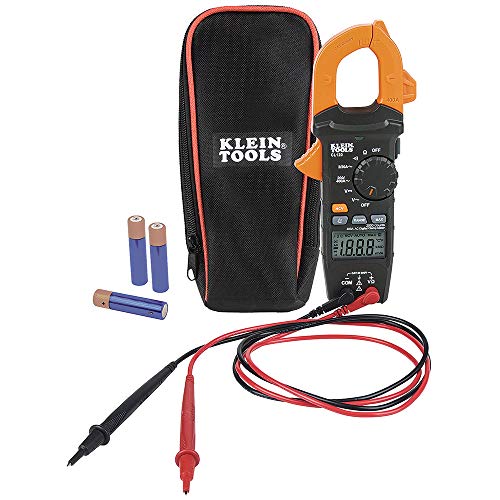
The Klein Tools CL120 combines a clamp for AC current with non-contact voltage testing (NCVT) and a separate test-lead section for AC/DC voltage, resistance, and continuity. It is best for electricians and pros who need quick current readings on live circuits and reliable voltage checks. The backlit display improves visibility in dim environments. A notable limitation is its current range, which may be less suitable for very high-load systems compared with deeper-capacity models.
AstroAI Digital Clamp Meter 2000 Counts

AstroAI’s model is a versatile option for those who want a balance of features and affordability. It measures AC current and voltage, resistance, capacitance, and continuity, plus live-wire testing and NCV. Best for DIYers or technicians handling routine electrical tasks. A caution: the meter’s DC current testing is not supported, so it cannot measure DC current directly through the clamp. This can limit use on DC-powered circuits unless reading voltage and resistance separately.
KAIWEETS Digital Clamp Meter

KAIWEETS offers a TRUE-RMS clamp meter with a distinctive D-shaped jaw that opens wide, making it easier to clamp around larger cables. It covers AC/DC current and voltage, temperature, NCV, capacitance, frequency, resistance, continuity, and diode tests. It’s a strong choice for electricians, HVAC and solar systems, and hobbyists who need reliable measurements in varied wiring configurations. The NCV feature is helpful, but users should ensure proper clamping to obtain accurate current readings. The device also provides audible and visual alarms for voltage detection.
Fluke 302+ Digital Clamp Meter

The Fluke 302+ is a compact, high-accuracy clamp meter capable of measuring AC current up to 400 A and AC/DC voltage up to 600 V. It is well-suited for professionals who require dependable performance in troubleshooting large loads and electrical systems. A potential limitation is that its feature set is narrower in some areas compared to full-featured Fluke models; it focuses on essential current and voltage readings with solid reliability.
Klein Tools CL120VP Electrical Voltage Test Kit

The CL120VP kit extends the CL120’s core clamp functionality with test leads and a pouch for convenient field use. It’s best for professionals who want an all-in-one test kit with reliable auto-ranging and NCVT, while keeping leads readily available for voltage and resistance measurements. A potential limitation is that the kit adds bulk and cost relative to a single-meter configuration, which may be overkill for users who only need basic current and voltage checks.
Klein Tools CL390 AC/DC Digital Clamp Meter
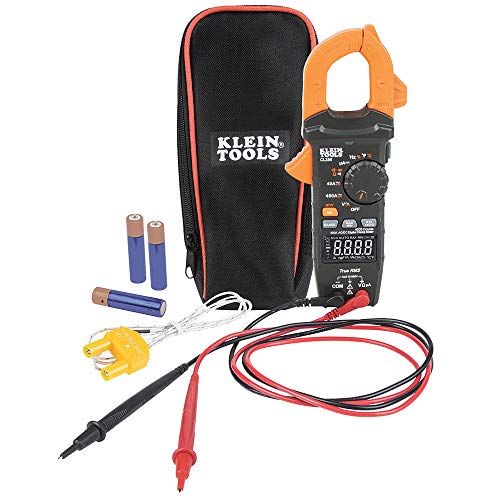
The CL390 is a high-range clamp meter with TRMS, NCVT, and a large display. It measures current and voltage across AC/DC, plus resistance, continuity, and additional functions like temperature, frequency, and microamps via test leads. It’s best for professionals who need a comprehensive tool for demanding electrical environments. A limitation is its bulk and higher price, which may deter casual users or those with lighter needs.
Buying Guide: Key Purchase Considerations
- Current range and AC/DC capability: Choose a model that supports the highest current you’ll encounter and that can measure both AC and DC where needed.
- Non-contact voltage testing (NCVT): Helpful for quick status checks and safer testing, but not a substitute for direct readings.
- Display and usability: Backlit or high-contrast displays improve readability; auto-ranging saves time and reduces user error.
- Jaw design and size: A wider D-shaped or larger jaw makes it easier to clamp around multiple conductors or larger cables.
- Additional features: Temperature, frequency, duty cycle, diode testing, and data hold can be valuable in complex diagnostic tasks.
- Portability vs. capability: Budget options are lighter and simpler, while professional-grade meters offer broader measurement ecosystems and durability.
FAQ
- What is a clamp meter best used for? It measures current without breaking the circuit and can also test voltage, resistance, and continuity.
- Do all clamp meters test DC current? No. Some models test AC current, while DC current capability varies by model.
- Is NCVT reliable for identifying live circuits? NCVT is a quick safety check but should not replace proper voltage testing with a meter probe.
- How important is the jaw size? A larger jaw accommodates bigger conductors and reduces the need to unplug or rearrange wires during measurement.
- What is TRMS, and why does it matter? True RMS provides more accurate readings on non-sinusoidal waveforms common in modern electronics and power supplies.
- Should I buy a kit or a single meter? Kits add convenience for fieldwork but cost more; choose based on whether you need the extra accessories.