
This guide helps buyers choose reliable outdoor motion sensor lights by comparing five top options. These lights prioritize security, energy efficiency, and easy installation for American homes. Each entry explains who it’s best for, why it was selected, and any notable limitations. Use the buying guide and FAQ to clarify differences and pick the right fit for your porch, driveway, yard, or garden.
| Product | Best For | Key Benefit |
|---|---|---|
| Daphino 2500LM Solar Lights Outdoor | Large outdoor areas and security-minded setups | Bright 2500LM from 156 LEDs with 3 modes |
| LUTEC 72W 7500LM Solar Flood Light (Black) | High-brightness, energy-efficient hardwired feel | 180° sensing, multiple modes, dusk-to-dawn |
| LUTEC 32W 3500LM LED Security Light | Budget-conscious outdoor lighting | Balanced brightness with 180° detection |
| nipify Solar Lights Outdoor (4 Pack) | Budget-friendly solar landscape lighting | Three modes with motion sensor, no wiring |
| HMCITY 120 LED Outdoor Lights | Open spaces with strong motion sensing | 120 LEDs, IP65, three modes |
Daphino 2500LM Solar Lights Outdoor

The Daphino unit features 156 high-efficiency LEDs delivering 2500 lumens with a 6500K daylight-white glow. It uses three installation-friendly modes that do not require a remote. Best for security-minded buyers who want high brightness and flexible evening lighting without wiring.
- Mode 1: Motion-Activated—off until motion is detected, then full brightness.
- Mode 2: Dim All Night—continuous, low-level illumination from dusk to dawn.
- Mode 3: Smart Security—low light that increases to full brightness on motion.
Best for: Driveways, fences, and wide entryways where strong, broad coverage is needed. Limitations: Solar-dependent brightness can vary with sun exposure and weather.
LUTEC 72W 7500LM Security Lights (Black)

This LUTEC model delivers high brightness with 7500 lumens at 5000K, and an energy-saving profile claimed to reduce electricity use by up to 88% compared with incandescent equivalents. It provides a 180° sensing range and adjustable timer options. Best for: Large garages, yards, and entryways requiring powerful coverage.
- Modes: Test, Security, Dusk to Dawn, and Manual Override.
- Note: A powerful option that may require mounting space and a stable power source for non-solar uses.
Why chosen: Its combination of brightness, wide detection, and flexible modes makes it a strong all-around option for homes needing conspicuous outdoor lighting. Caution: Installation may be more complex if wiring isn’t straightforward.
LUTEC 32W 3500LM LED Security Light
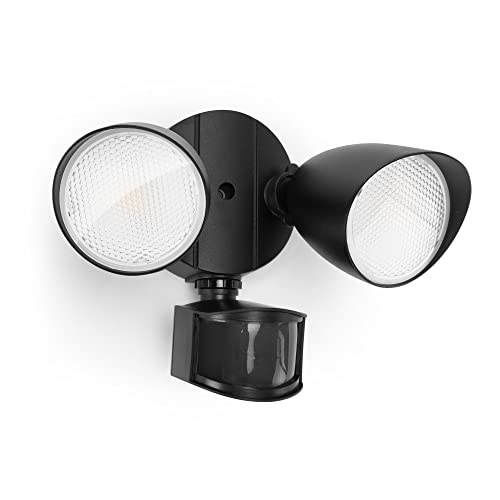
With 3500 lumens at 5000K, this LUTEC fixture balances brightness and efficiency. It features a broad 180° motion sensor and four modes, including a manual override. Best for: Mid-sized outdoor spaces where cost-conscious energy savings are important.
- Modes: Test, Security, Dusk to Dawn, Manual Override.
- Limitation: Lower brightness than the 72W model, but uses less energy overall.
Why chosen: It offers a practical, cost-efficient option for homeowners who don’t need maximum brightness but want reliable sensing and lighting control.
nipify Solar Lights Outdoor (4 Pack)

These solar landscape spotlights use built-in PIR motion sensors and come in a 4-pack. They offer three modes: motion-activated, dim sensor mode, and constant night light. Ideal for budget-minded buyers who want flexible outdoor lighting without wiring. Best for: Pathways, garden borders, and deck perimeters where solar charging is preferred.
- Modes: Sensor light, Dim light sensor, Constant light.
- Limitation: Solar efficiency depends on sun exposure and location.
Why chosen: The 4-pack format provides scalable, cost-effective coverage for larger outdoor areas.
Ring Floodlight Cam Wired Plus

Ring Floodlight Cam Wired Plus combines motion-activated 1080p video with floodlights and an audible siren. Real-time alerts and customizable motion zones add a security-focused dimension beyond lighting alone. Best for: Homeowners seeking integrated video and lighting for deterrence and monitoring.
- Capabilities: Motion-triggered lighting, 1080p video, siren, customizable motion zones.
- Limitation: Wired installation and ongoing connectivity requirements.
Buying Guide: Practical Considerations For Outdoor Motion Sensor Lights
- Where to place lights: Position to maximize motion detection angles while avoiding direct glare into windows. Place lights at entryways, driveways, and along walkways for best coverage.
- Brightness vs. energy use: Higher lumens provide stronger illumination but may drain power faster for solar options. Balance brightness with sensor sensitivity and mode options.
- Power source: Choose solar for easy installation and lower running costs, or wired for consistent brightness and reliability, especially in areas with limited sun.
- Sensor range and accuracy: Look for PIR sensors with wide detection angles (generally 180°) and reach up to about 40 feet or more. Consider adjustable heads for targeted coverage.
- Mode variety: Favor models offering multiple modes (motion-activated, dim, dusk-to-dawn, and manual override) to adapt to seasonal lighting needs.
- Durability: IP65 or higher rating ensures weather resistance. Materials like UV-stable plastics or metals improve longevity in harsh climates.
- Ease of installation: Check for tool-free mounting options and compatibility with existing electrical setups if wiring is involved.
- Smart integration: Some options offer camera, app alerts, or custom zones for enhanced security. Decide whether you want smart home compatibility or standalone functionality.
Frequently Asked Questions
- What is the best motion sensitivity for outdoor lights? – A balance of sensitivity and false trigger prevention. Look for sensors with adjustable sensitivity and mounting height around 8–12 feet for optimal coverage.
- Do solar motion lights work in winter? – They rely on daylight charging; shorter days can reduce brightness or active hours. Choose models with higher efficiency and longer battery life for colder months.
- Can I install these lights myself? – Most models support DIY mounting with basic tools. Wired options may require electrical know-how and adherence to local codes.
- How many lumens do I need for safe outdoor lighting? – For entryways and porches, 700–1500 lumens per fixture is common. For larger areas, 2000–7500 lumens across multiple fixtures is typical.
- What’s the difference between dusk-to-dawn and motion-activated modes? – Dusk-to-dawn provides continuous low light at night; motion-activated turns bright only when movement is detected, saving energy.
- Are these lights weatherproof? – Look for IP65 or higher. Waterproof or water-resistant ratings indicate suitability for rain and snow exposure.