
Answering your moisture barrier questions: choose a product that best matches your flooring project—whether you need a sealant before coating, a vapor barrier underlayment, or a self-leveling primer. This guide highlights five top options for American buyers, detailing who each product is best for and why. Suitable for basements, garages, and concrete slabs, these selections address moisture, bonding, and ease of installation. Use the included buying guide to compare options and pick the right barrier for your floor type and project scope.
| Product | Brand | Best For |
|---|---|---|
| Rust-Oleum 301239 Concrete Moisture Stop Fortifying Sealer | Rust-Oleum | Pre-coating moisture seal and prep for coatings on concrete floors |
| ROBERTS 70-116 Moisture Barricade | ROBERTS | Vapor barrier underlayment for vinyl, laminate, SPC, engineered wood |
| Moisture/Vapor Barrier Underlayment (MP Global) | MP Global Products | Underlayment barrier with self-sealing tape for fast seam installation |
| Magic Resin | Moisture Vapor Barrier Floor Epoxy Resin | Magic Resin | DIY moisture protection and bond-enhancing primer for coatings |
| SIKA Sikalevel Self-Leveling Underlayment Primer | SIKA | Primer that prevents water loss when used with self-leveling underlayment |
Rust-Oleum Concrete Moisture Stop Fortifying Sealer
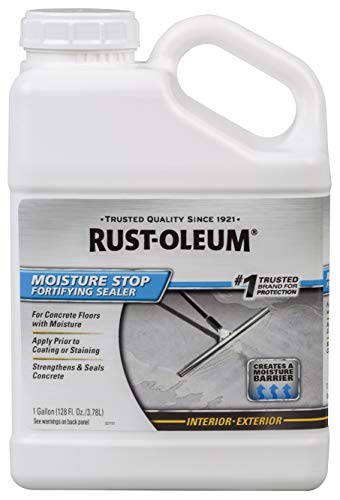
Best For: Home garages and concrete floors awaiting coating, where a clear sealant is needed without changing surface appearance.
- Seals concrete floors and prevents moisture from reaching coatings.
- Bonds and seals without altering the surface appearance.
- Application: penetrate for about 45 minutes; covers up to 200 sq. ft. per gallon.
Why selected: It’s a straightforward, finish-preserving sealer that prepares concrete for subsequent coatings, making it ideal for DIYers and homeowners focusing on moisture control before finishes. Caution: may require multiple coats for larger areas.
ROBERTS 70-116 Moisture Barricade

Best For: Subfloor vapor barriers under vinyl, laminate, SPC, and engineered wood, especially when a floating or thin-profile product is needed.
- 6 mil polyethylene film designed as a vapor barrier over concrete subfloors.
- Exceeds NWFA requirements for moisture barriers under certain floorings.
- Installation note: good with laminate with pre-attached underlayment and other floating resilient floors.
Why selected: It adds a strong moisture barrier for a range of floor types, helping prevent subfloor moisture from affecting finished floors. Caution: Requires careful seam sealing and overlap handling for best performance.
MP Global Moisture/Vapor Barrier Underlayment

Best For: Laminate and engineered floors requiring a moisture barrier with easy installation features.
- Thin (.006 Mil) polyethylene film for moisture control.
- Self-sealing adhesive tape aids seam installation for a clean, continuous barrier.
- Roll-and-tape installation approach reduces gaps and future peel-back risks.
Why selected: Its self-sealing tape and thin profile make it a practical choice for quick installations in homes and light-commercial spaces. Caution: Verify compatibility with your flooring’s underlayment before use.
Magic Resin Moisture Vapor Barrier Floor Epoxy Resin

Best For: DIY enthusiasts and garages needing a dual-function product that blocks moisture and primes for epoxy or coating systems.
- Blocks high moisture vapor emissions to prevent bubbling, peeling, and delamination.
- Acts as a strong bonding base to improve adhesion of epoxy coatings and other overlays.
- Cures into a durable, chemical- and abrasion-resistant surface for heavy use.
Why selected: Combines vapor barrier with a bonding primer, reducing steps for a DIY coating project. Caution: It is primarily a primer/barrier and should be used in conjunction with compatible coatings as directed.
SIKA Sikalevel Self-Leveling Underlayment Primer

Best For: Use with Sika self-leveling underlayment to create a moisture-resistant and highly bonded surface before leveling concrete floors.
- Ready to use; no dilution required.
- Prevents water loss from underlayment into the substrate.
- White gallon, ready for immediate application with compatible Sikalevel products.
Why selected: Ideal as a bonding primer in conjunction with self-leveling underlayment for moisture-sensitive substrates. Caution: Must be used with compatible Sikalevel underlayment systems for best results.
Buying Guide: Key Considerations For Choosing A Concrete Moisture Barrier
What type of barrier do you need?
Decide between a surface sealer, a vapor barrier underlayment, or a self-leveling primer. Sealers protect the surface while maintaining appearance; vapor barriers prevent moisture migration; primers support coating adhesion and leveling.
Project type and flooring next steps
For coatings: choose a concrete sealer that won’t yellow or alter texture. For new floors or renovations: a vapor barrier underlayment with reliable seam integrity is essential. For DIY epoxy or coatings: a moisture barrier that also acts as a primer can reduce steps and save time.
Coverage, thickness, and installation
Consider area coverage per unit, thickness requirements (mil or mils), and whether the product uses self-sealing seams or tape for fast installation. Larger spaces benefit from products with simple application and clear cure times.
Compatibility and substrate readiness
Ensure the product is compatible with your substrate (concrete, existing coatings, or backings) and with the intended final flooring material. Check for any substrate-specific limitations or required surface preparation steps.
Durability and performance expectations
Look for barrier products that resist chemical exposure, abrasion, and everyday wear if the space will see high traffic or contain vehicles, tools, or spills.
Safety and environmental considerations
Review ventilation needs, cure times, and any odor or chemical warnings. Choose options that align with your indoor air quality goals and local building codes.
Frequently Asked Questions
- What is the difference between a moisture barrier and a moisture sealant?
Answer: A moisture barrier blocks moisture transmission at the subfloor or concrete level, while a moisture sealant protects the surface finish from moisture intrusion and helps coatings adhere. - Can I install a vapor barrier over an already finished floor?
Answer: It depends on the floor type and underlayment; in many cases, a barrier is installed beneath the new flooring or coatings rather than over an existing finished surface. - Is self-leveling underlayment suitable for all concrete floors?
Answer: Not every floor; some surfaces require different primers or sealers before leveling, so follow manufacturer guidelines. - Do moisture barriers affect the appearance of the floor?
Answer: Surface sealers usually preserve appearance; vapor barriers beneath flooring are not visible in the finished space. - How long should I wait before applying coating after sealing?
Answer: Cure times vary by product; check product labels for recommended recoat windows and cure durations. - Are these products safe for basements with high humidity?
Answer: Yes, several products are designed to manage moisture and prevent vapor transmission in basement settings when installed correctly.