
When choosing a portable power station for camping, emergencies, or off‑grid living, longevity matters as much as capacity. This guide highlights five long‑lasting models with lithium iron phosphate (LiFePO4) batteries, strong lifespans, and robust output. Each entry includes key specs to help compare durability, recharge speed, and overall reliability in real-world scenarios.
| Product | Brand | Capacity (Wh) | LiFePO4 Battery | Approx. Lifespan (cycles) |
|---|---|---|---|---|
| Jackery Explorer 1000 v2 | Jackery | 1070 | LiFePO4 | ~3000 |
| OUPES Mega 1 | OUPES | 1024 | LiFePO4 | 3,000+ |
| EF ECOFLOW Delta 2 | EF ECOFLOW | 1024 | LiFePO4 | Up to 3,000+ |
| Anker SOLIX C1000 Gen 2 | Anker | 1024 | LiFePO4 | ~4,000+ |
| VTOMAN Jump 600X | VTOMAN | 299 | LiFePO4 | ~3,000 |
Jackery Explorer 1000 v2 Portable Power Station

Capacity and longevity define this model. The Explorer 1000 v2 delivers 1,070Wh of LiFePO4 storage, with a capable 1,500W continuous AC output and a 3,000W surge. Its lightweight design (about 23.8 lbs) and a 10-year service horizon in practical terms rely on a durable LiFePO4 chemistry that maintains capacity through thousands of cycles. Fast charging via the Jackery App enables approximately one-hour top‑ups, making it a strong candidate for frequent use in outdoor trips or emergencies.
OUPES Mega 1 Portable Power Station
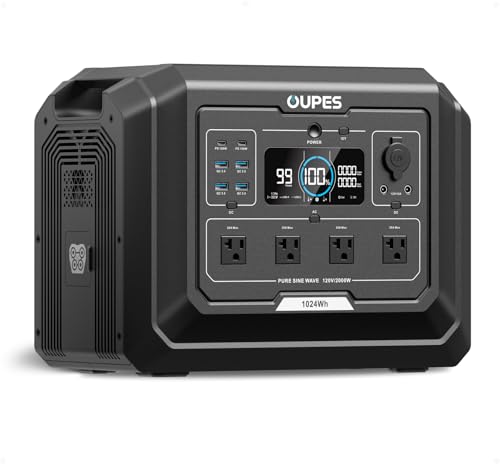
The OUPES Mega 1 stands out for expandability and high‑capacity LiFePO4 storage. With 1,024Wh onboard and support for expansion to 5,120Wh when paired with an extra battery, it targets long trips or off‑grid scenarios. The 2,000W continuous AC output (4,500W peak) covers larger appliances, while dual charging speeds (up to 1,400W) enable very fast recharging. Its LiFePO4 chemistry provides thousands of cycles, contributing to a long service life and reliable performance for years of use.
EF ECOFLOW Delta 2 Portable Power Station

The Delta 2 is a high‑output LiFePO4 powerhouse with 1,024Wh capacity and 1,800W continuous AC power, plus 15 outlets for broad appliance support. Its 7× faster charging claims (0‑80% in about 50 minutes, 0‑100% in ~80 minutes) make it highly practical in time‑constrained situations. The option to expand capacity with additional batteries enables adaptation to longer off‑grid stays, while the LiFePO4 chemistry supports thousands of cycles and extended longevity.
Anker SOLIX C1000 Gen 2 Portable Power Station

The Anker SOLIX C1000 Gen 2 combines a robust 1,024Wh LiFePO4 battery with a broad 2,000W continuous output and up to 3,000W peak. It emphasizes uptime during outages or remote excursions, with a compact form factor that improves portability. Advanced charging, including HyperFlash technology in the app, supports rapid recharging to minimize downtime. The device is engineered for durability and long service life with frequent use in demanding environments.
VTOMAN Jump 600X Portable Power Station

The Jump 600X focuses on safety and reliability with a LiFePO4 battery and a Supersafe LIFEBMS protection system. It delivers 600W continuous output with a 1,200W surge, and its 299Wh capacity is suited for compact load‑out scenarios. The product supports long cycles (thousands of uses) and features add‑on battery options to extend total usable capacity for extended camping or emergency planning.
Buying Guide: Key Purchase Considerations
- Battery chemistry and lifespan: LiFePO4 cells offer longer cycle life and better thermal stability than many alternatives, translating to a longer overall service life in routine use.
- Capacity and real‑world needs: Choose a watt‑hour rating that aligns with your typical loads (CPAP devices, fridges, portable AC, laptops). Consider whether expansion options are valuable for longer trips.
- Output power and surge handling: Ensure the model can handle your heaviest appliances (stoves, heaters, power tools) without tripping or shutting down.
- Recharging options and speed: Fast AC charging, solar compatibility, car charging, and MPPT efficiency reduce downtime between uses, especially on multi‑day excursions.
- Weight, size, and portability: Heavier units offer more capacity but may be less convenient to move. Consider handles, wheels, and overall ergonomics for travel.
- Safety and longevity features: BMS protections, over‑charge/over‑discharge safeguards, and thermal management are essential for reliable operation and longevity.
- Expandability: Some models support additional batteries or modular packs to scale capacity for longer outages.
- Real‑world use cases: For home backup, prioritize higher continuous power and reliability; for camping, prioritize portability and ease of use; for RVs, balance both容量 and output.
Across these options, the five highlighted models emphasize longevity through LiFePO4 chemistry, strong cycle lifespans, and scalable capacity. Whether the priority is quick top‑ups, sustained high power, or long‑term off‑grid reliability, these units offer robust, durable solutions for American households and outdoor enthusiasts alike.