
For travelers, campers, and outdoor enthusiasts, lightweight solar panels offer reliable energy without carrying heavy bundles. This guide highlights compact, flexible, and portable options that fit curved surfaces, backpacks, or vehicle roofs while delivering solid performance. Each product below is selected for portability, efficiency, and field readiness to help you choose the right balance of weight, output, and ease of use.
| Product | Brand | Output (W) | Weight (approx.) | Best For |
|---|---|---|---|---|
| Renogy 200W Flexible Panel | Renogy | 200 | ~1/2 rigid panel weight | Curved surfaces, mounting versatility |
| Renogy 100W Flexible Panel | Renogy | 100 | ~1/3 rigid panel weight | Compact, portable setups |
| OPTISOLEX 440W Solar Bag | OPTISOLEX | 440 | 16.9 lb (approx.) | High output in a foldable system |
| ECO-WORTHY 260W (2×130W) | ECO-WORTHY | 260 | varies by configuration | Flexible mounting on irregular surfaces |
| BigBlue 25W Portable | BigBlue | 25 | 0.84 lb | Phone and small device charging on the go |
Overview notes: The list focuses on lightweight, flexible, or compact solar panels that are suitable for camping, RVs, boats, and other mobile uses. Each entry includes a quick look at the technology, portability, and everyday practicality to support informed decisions about off-grid power in varying sunlight conditions.
Renogy 200W Flexible Solar Panel for Curved Surfaces

Renogy’s 200W flexible solar panel is designed for curved installations, with a 240-degree bend radius that accommodates rounded surfaces on boats, RVs, cabins, and vehicles. It weighs roughly half the weight of a rigid panel, offering easy transport and discreet all-black aesthetics with glare-free performance. The panel uses half-cut PERC cell technology to optimize light capture and electrical efficiency, helping maximize daily energy production in moderate sun.
Key takeaway: The combination of high power density and flexible mounting makes this panel a strong choice for mobile setups where weight and adaptability matter most. Ideal for marine or automotive installations where rigid hardware would be impractical.
Renogy 100W Flexible Solar Panel
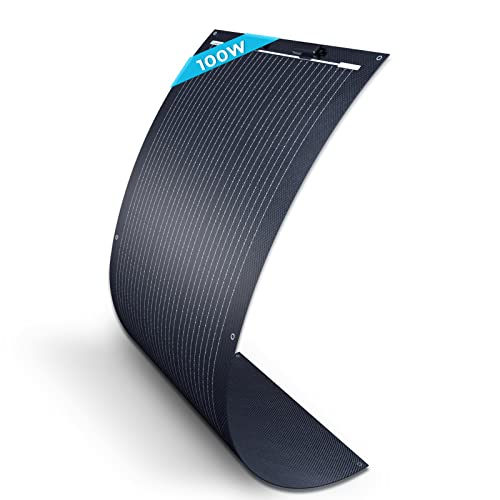
The Renogy 100W flexible option emphasizes portability while maintaining robust performance. It provides an estimated 500 Watt-hours per day under favorable sun conditions, depending on location and weather. The panel’s 240-degree bend capability supports curved installations with minimal weight, and its half-cut PERC cell tech boosts conversion efficiency. It remains a reliable choice for compact, on-the-go power needs.
Consideration: This size is well-suited for smaller RV sections, campers, or secondary batteries where space and weight savings are valuable without sacrificing too much daily energy yield.
OPTISOLEX 440W Solar Bag

The OPTISOLEX Solar Bag is a 440W foldable system that splits into two 220W panels. It weighs about 17.2 pounds and uses N-type cells with up to 25% efficiency. The two panels can fold independently, enabling flexible placement and simultaneous charging of an RV battery and a power station. It prioritizes portability while delivering high total output for larger-scale off-grid needs.
Consideration: This option suits longer trips or setups requiring higher daily energy with transportable, weather-resistant charging while maintaining a relatively light footprint for the system’s total wattage.
ECO-WORTHY 2×130W Flexible Panels

ECO-WORTHY offers a two-panel 260W flexible bundle with 130W per panel. The kit emphasizes high flexibility and waterproofing for RVs, boats, and curved surfaces. Each panel claims up to 23.5% efficiency, with a daily output potential around 520Wh under four hours of good sun and a total daily average that can approach 1040Wh with suitable conditions. Quick installation holes and versatile fixing options support semi-permanent or temporary setups.
Consideration: This pair is ideal when you need more total output than a single panel but still value lightweight design and flexible mounting for irregular surfaces.
BigBlue Ultra-Light 25W Pocket Solar Panel

BigBlue’s 25W portable charger is designed for personal device charging on the go. It folds to the size of an iPad and weighs about 0.84 pounds, making it a top pick for hikers and backpackers. USB-A and USB-C ports provide versatile charging for phones, power banks, and small gadgets. The module uses high-efficiency N-type cells and delivers up to 25.4% conversion efficiency under ideal conditions, with smart charging safety features for protected use outdoors.
Consideration: This compact solution excels for individual device charging, emergency power, or supplementary energy in backpacking, camping, or travel where space is extremely limited.
RENOGY REGO 200W Portable Solar Blanket

The Renogy REGO 200W solar blanket is a compact, foldable N-Type panel system designed for portability. Weighing around 8.82 pounds, it is notably smaller and lighter than many 200W competitors. It unfolds to resemble the width of an SUV or pickup truck front, offering a flexible setup for camping, RVs, and marine use. The system emphasizes a balance of high efficiency (25% class) and a compact footprint for travelers who prioritize packability.
Consideration: Best for travelers needing substantial wattage without adding bulk to luggage or vehicle storage, with easy setup in variable sun conditions.
Buying Guide: Key Considerations for Lightweight Solar Panels
- Weight vs. Output: Heavier panels can yield more energy, but lightweight options enhance portability. Compare watts per pound (W/lb) to assess efficiency per load carried.
- Flexibility and Mounting: Flex panels excel on curved surfaces and irregular roofs. Consider bend radius, mounting hardware, and whether adhesive, straps, or brackets are preferred for your use case.
- Cell Technology: Half-cut PERC or N-type cells improve efficiency and heat tolerance. Higher efficiency helps in limited sun exposure scenarios.
- Portability Configurations: Foldable bags, blankets, and compact panels offer varying deployment speeds. For long trips, foldable systems may balance space, weight, and storage ease.
- Durability and Weather Resistance: Look for waterproofing, ETFE or similar protective laminates, and robust frames. Outdoor gear should withstand rain, dust, and sunshine exposure.
- Versatility of Use: Some kits support charging multiple devices or secondary storage packs simultaneously. Evaluate whether the system can charge both a battery bank and a device or power station at once.
- Expandability: If you anticipate higher energy needs later, consider systems that couple with additional panels or can be upgraded without replacing existing components.
- Maintenance and Warranty: Portable solar gear benefits from straightforward maintenance and reliable warranties. Check for included hardware, spare parts, and service terms.
In choosing a lightweight panel, align your power goals with your transport constraints. For small device charging or emergency power on a hike, a compact 25W or 100W flexible panel can be sufficient. For RVs, boats, or longer trips requiring higher daily energy, consider a foldable 260–440W system, weighing options between a single high-output panel and split configurations. Always match operating conditions with expected sun exposure to estimate daily energy more accurately.