
American consumers increasingly seek affordable, high-efficiency solar panels sourced from China for camping, RVing, and emergency backup. This article highlights five well-regarded 200W class or near-compatible panels, emphasizing foldable or portable designs, durable build quality, and reliable performance in outdoor use. Each product is evaluated on efficiency, portability, and ease of use, helping you compare options for limited spaces, varied weather, and off-grid setups. Read on to learn which panels best meet needs for camping, power stations, and remote living environments.
The following summary table provides a quick glance at the chosen products. Note: performance may vary with sunlight, temperature, and integration with your power station or batteries.
| Product | Brand | Approx Power |
|---|---|---|
| Renogy 200W Portable Solar Panel | Renogy | 200W |
| SOKIOVOLA N-Type 200W Portable Solar Panel | SOKIOVOLA | 200W |
| DOKIO 150W Portable Foldable Panel Kit | DOKIO | 150W |
| Ecosonique 200W Portable Solar Panel | Ecosonique Technology | 200W |
| EBL 100W Portable Solar Panel | EBL | 100W |
Renogy 200W Portable Solar Panel

Renogy’s 200W foldable panel uses advanced N-Type cell technology and a 16BB configuration to deliver up to 25% efficiency, surpassing many conventional 9BB designs. The foldable, lightweight design weighs about 13.89 pounds, packing to compact dimensions for easy transport. An EFLEX foldable form with magnetic closures simplifies setup in tight spaces such as SUVs and small campers. It features a USB-C PD port and USB-A outputs, enabling charging for smartphones, tablets, and cameras, while MC4 output supports charging portable power stations or 12V batteries. Ideal for RVs, camping, and emergency backup needs.
SOKIOVOLA N-Type 200W Portable Solar Panel
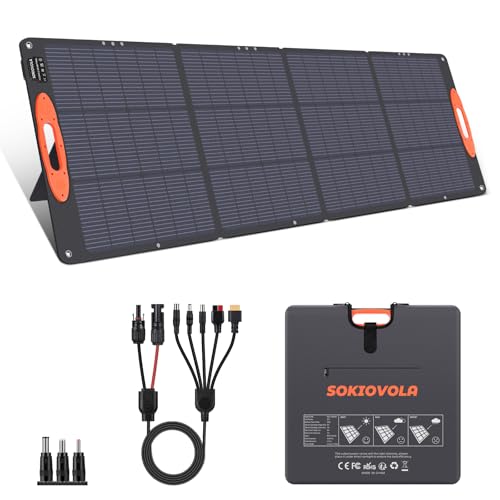
SOKIOVOLA offers a 200W foldable panel built on high-efficiency monocrystalline cells with up to 25% conversion, designed for camping and off-grid use. Its IP68 waterproof rating supports rugged outdoor conditions, while the foldable design and magnetic handle simplify transport. The panel includes multiple mounting options for RVs and trailers. Aimed at users seeking reliable energy generation in variable weather, it pairs well with Jackery, Bluetti, or similar power stations, and can charge multiple devices via USB-C PD and USB-A outputs.
DOKIO 150W Portable Foldable Solar Panel Kit

DOKIO delivers a compact 150W solution with a standalone PWM controller, enhancing safety and ease of use for 12V battery systems. Its 7.3-pound weight and 21×20 inch profile make it travel-friendly for RVs and campers. The kit includes a longer 9.8-foot cable to position the panel in sun while keeping the controller shaded, boosting efficiency through cooler operation. The modular design facilitates easy replacement or upgrade of the controller, battery, or cables as needed for ongoing off-grid use.
Ecosonique 200W Portable Solar Panel

Ecosonique presents a compact 200W option with a lightweight 10.6-pound frame and a 6-fold design. It folds to 18″ x 16.3″ and includes multiple output options, including MC4 direct output and USB-C PD3.0 plus USB-A QC3.0 for direct device charging. The panel supports wide compatibility with popular power stations and devices, and its kickstand-enabled setup helps optimize sun exposure. Its high efficiency—up to 23.5%—facilitates faster charging in outdoor environments.
EBL Solar Panel 100W Portable Solar Panel

EBL’s 100W portable solar panel emphasizes compatibility and safety. It includes multiple connector options to match various generators and power stations, along with a smart IC protecting against overcharging, overheating, and short circuits. The panel folds with a built-in kickstand for angled sun exposure, and a magnetic handle aids compact storage. With lightweight construction and reliable charging performance, it provides a versatile option for camping, hiking, and emergency power needs in off-grid settings.
Buying Guide
- Efficiency and cell technology: Look for N-Type or high-efficiency monocrystalline panels (27% or higher in some models are claimed) to maximize output in limited sun. Anti-shading features and 16BB or similar cell configurations can reduce power loss in partial shade.
- Portability and weight: If you need to transport and set up quickly, prioritize foldable designs under 15 pounds and compact folded dimensions. Magnetic closures and kickstands add convenience for mobile use.
- Durability and weather resistance: For outdoor use, IP ratings (IP65 or IP68) and robust coatings (ETFE) improve water, dust, and UV resistance. Rigid frames and reinforced grommets support mounting on RVs, boats, or tents.
- Output options: Ensure compatibility with your power station or battery bank. Panels with USB-C PD, USB-A QC, and MC4 outputs provide flexible charging for phones, laptops, and small devices in addition to powering larger storage units.
- System integration: Consider whether the panel includes a separate controller or if you need to purchase one. A separate controller can offer advanced protections (reverse polarity, overcharge, overcurrent) and easier replacement.
- Portability versus power trade-off: Higher wattage panels deliver more energy but can be heavier. Choose a panel that balances weight, space, and your energy needs for trips, backups, or remote living scenarios.
- Warranty and support: Review manufacturer warranties and customer support options. A solid warranty can mitigate field issues from rugged use or transport.