
The pursuit of high wattage solar panels for RVs, cabins, boats, and off-grid homes has intensified as demand for reliable, scalable solar energy grows. This guide highlights top high-wattage options, emphasizing efficiency, shading resistance, and durability in real-world setups. Explore panel designs that maximize output in compact footprints and withstand challenging conditions.
| Product | Wattage | Type | |
|---|---|---|---|
| Callsun N-Type 16BB 400W (2-Pack 200W) | 400W total (2 x 200W) | N-Type, Monocrystalline, Bifacial | Bifacial design for extra rear-side energy |
| Renogy 400W ShadowFlux N-Type (2 x 200W) | 400W total | N-Type, Monocrystalline | ShadowFlux anti-shading tech reduces hotspots |
| Rvpozwer 400W Solar Panel (4 x 100W) | 400W total | N-Type, Monocrystalline | High conversion efficiency, durable frame |
| Renogy 400W 24V Panel (2 x 200W) | 400W total | N-Type, 16BB | Compact, high efficiency for 24V systems |
| Renogy 200W ShadowFlux N-Type | 200W | N-Type, Monocrystalline | Anti-shading tech for shaded conditions |
Note: The table above groups five high-watt panels that are well-suited for off-grid installations, including RVs, marine applications, and cabins. Each entry links to its respective product page for more details on specs and compatibility.
Callsun N-Type 400W Twin Pack

Callsun combines N-Type 16BB cell technology with a bifacial design and dual-module architecture. The 200W per panel configuration delivers higher efficiency with up to 25% conversion, improving output in various lighting conditions. The bifacial feature captures rear-side energy from reflections, increasing total power by as much as 30%. The TwinCell anti-shade layout ensures that shading on one half does not completely disable the other, enhancing reliability in environments with partial shading.
Renogy 200W Portable Solar Panel

Renogy’s portable 200W panel features upgraded 16BB N-Type cells delivering up to 25% efficiency, allowing more power from limited space. The foldable design, lightweight construction (about 13.89 lbs), and magnetic closure simplify transport and setup in camping, RVs, or on boats. It offers versatile charging with USB-C PD, USB-A, and MC4 outputs for compatibility with power stations and battery banks, supporting multiple devices simultaneously while on the go.
Renogy 400W ShadowFlux N-Type Panels

Renogy’s 400W ShadowFlux panels employ N-Type cells with 16BB technology for 25% efficiency and reduce hot spots and micro-cracks, extending lifespan. The ShadowFlux anti-shading approach helps maintain energy output in partially shaded conditions, an important consideration for rooftop installations where obstruction from trees or architectural features can occur. The panels are designed to be compact and lighter than traditional PERC designs, facilitating easier mounting on RVs or boats.
Rvpozwer 400W Panel Set
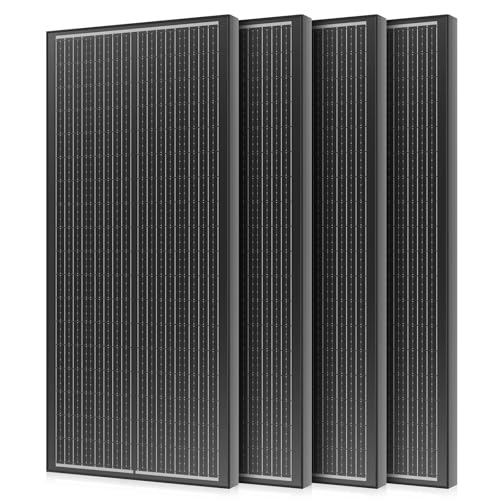
Rvpozwer offers a 400W configuration built from four 100W panels with 18BB N-Type cells, achieving high efficiency around 25%. The design emphasizes a robust aluminum frame and weather-resistant construction, with specifications indicating long service life and compatibility with various off-grid systems. The 18BB architecture helps minimize hotspot risk while maximizing energy capture, even in challenging outdoor environments.
Renogy N-Type 400W (2-Pack 200W)

This Renogy pair uses N-Type cells with 16BB configuration to achieve 25% efficiency in a compact 400W setup. The design emphasizes a lighter, more compact footprint compared to older models, making it suitable for tight spaces in vans or small boats. The system supports 12V and 24V battery configurations, broadening its applicability for home, RV, and marine installations. The smaller form factor helps with easier roof fitting and improved airflow to reduce heat-related losses.
Renogy 200W ShadowFlux N-Type

Renogy’s 200W ShadowFlux panel leverages N-Type cells with 16BB technology for 25% efficiency and reduced hotspot risk through ShadowFlux anti-shading. This compact 200W solution is ideal for adding power in tight spaces on RV rooftops, marine vessels, or off-grid sheds, delivering reliable energy with enhanced shading tolerance. Its lightweight design facilitates easier handling during installation and maintenance.
Buying Guide: Key Considerations for High-Wattage Panels
- Cell Type and Efficiency: N-Type (16BB) cells are common in high-wattage panels due to higher efficiency and reduced degradation in high-temperature environments. Look for panels advertised at 25% efficiency or higher for maximum output per square foot.
- Shading Resilience: Anti-shading technologies like ShadowFlux or twin-cell designs help maintain output when portions of the panel are shaded. This is crucial for roof installations with partial obstruction.
- Bifacial Capability: Bifacial panels can generate additional energy by collecting light from the rear surface. This feature increases total energy yield in reflective environments (snow, water, white rooftops), but effectiveness varies by mounting and terrain.
- Durability and Build: Off-grid panels should withstand wind, snow, and moisture. Aluminum frames, tempered glass, and IP ratings indicate robustness for outdoor use on roofs, boats, or outdoor sheds.
- System Compatibility: Consider voltage and battery compatibility (12V vs. 24V, or larger bank systems). Ensure wiring, MC4 connectors, and charge controllers are compatible with a 400W or higher configuration.
- Portability vs. Fixed Installations: Portable 200W panels offer flexibility for campers and emergency setups, while fixed 400W sets maximize output for permanent installations on RVs or cabins.
- Maintenance and Longevity: Panels with proven longevity and warranties provide peace of mind for long-term off-grid use. EL testing and 25-year expectations are common benchmarks.
- Installation Space: Higher-watt panels require sufficient mounting area. Measure roof or deck space to ensure proper fit and ventilation for cooling to maintain efficiency.