
Finding the right hardwood floor nailer can determine the speed and quality of your installation. This guide highlights five reliable options that cover common flooring needs—from light-duty projects to heavy-duty professional jobs. The selections cater to DIY homeowners, cabinetmakers, and contractors who want dependable performance, easy depth adjustment, and versatile fastener compatibility. Below is a quick buyer’s table to compare the best choices at a glance.
| Product | ||
|---|---|---|
| Bostitch Flooring Pneumatic Nailer | General hardwood installs with staples and cleats | Interchangeable bases for different flooring thicknesses |
| DEWALT 2-in-1 Flooring Nailer (DWFP12569) | Lightweight, versatile tool for mixed solid and engineered floors | Non-marring base plates and broad fastener compatibility |
| Metabo HPT 2-in-1 Flooring Nailer & Stapler (N5010AC) | Durable aluminum magazine, easy reloading | Accepts 16-gauge cleats and 15.5-gauge staples up to 2″ |
| WEN 61741K 4-in-1 Flooring Nailer | Versatile tool for brads and staples in one unit | Angled 45-degree fastening via removable shoe |
| Freeman P50LSLW 2-in-1 Flooring Nailer/Stapler | Budget-friendly option with durable aluminum build | Interchangeable base plates; suitable for common hardwoods |
Bostitch Flooring Pneumatic Nailer

The Bostitch model drives 15.5-gauge staples and 16-gauge L-shaped cleats, accommodating 1-1/2″ to 2″ fasteners. It uses mallet-actuated pneumatic driving, offering controlled placement for flush installs. Interchangeable base plates cover 1/2″ to 3/4″ flooring, making it versatile for thinner plywood to thicker planks. Best for DIYers and remodelers who want a reliable, easy-to-control tool for standard hardwood projects. A potential limitation is handling longer boards where user fatigue may increase during extended sessions.
Why it’s selected: Solid mid-range performance, strong consistency with staple and cleat fasteners, and user-friendly base plate adjustments support common tongue-and-groove flooring tasks.
Caution: Non-marring base plates help protect planks, but ensure correct depth settings to avoid dulling edges on delicate finishes.
3PLUS HFSNSP 2-in-1 Pneumatic Flooring Nailer/Stapler

This 2-in-1 tool handles 15-1/2 gauge staples and 16-gauge L cleats, spanning 1-1/2″ to 2″. It includes interchangeable flooring plates suitable for various flooring sizes and a removable long-reach handle for improved reach in tight areas. Best for budget-conscious pros and DIYers needing a versatile nailer-stapler combo that covers most solid or engineered hardwood floors. Limitation: assembly and conversion between nailer and stapler modes may require additional time on busy jobs.
Why it’s selected: Combines staple and cleat capabilities in one tool, expanding fastening options without buying multiple devices. The removable handle aids operation in cramped spaces.
Metabo HPT 2-in-1 Flooring Nailer & Stapler (N5010AC)

The Metabo HPT N5010AC provides a 2-in-1 capability for 16-gauge L-shaped cleats and 15.5-gauge 1/2″ crown staples, with a practical depth-adjustment range and tool-less depth settings. The aluminum magazine ensures durability and smooth reloads. Best for professional wood flooring installs where reliability and quick reloads are essential. A potential limitation is that higher-volume projects may benefit from a larger-capacity magazine for fewer interruptions.
Why it’s selected: Renowned durability and a straightforward adjustment system suit high-precision flooring work. The tool-less depth control helps maintain consistent boards across sessions.
DEWALT Flooring Stapler, 2-in-1 Tool

DEWALT’s 2-in-1 design emphasizes lightweight handling at around 10.6 lbs, aiding balance during longer installs. It’s optimized for popular solid flooring fasteners, supporting 15.5-gauge staples and 16-gauge L-cleats. Interchangeable, non-marring base plates adapt to different flooring thicknesses. Best for professionals and serious DIYers who value maneuverability and a broad fastener range. Limitation: On very dense woods, you may need to test depth adjustments for consistent seating.
Why it’s selected: Combines light weight with solid versatility, enabling faster work with fewer wrist strains. The non-marring bases help protect finished surfaces during meticulous installs.
3PLUS HFS509040SP 4-in-1 Pneumatic 18 Gauge Flooring Stapler/Nailer

This 4-in-1 tool uses 18-gauge brads (3/4″–2″) and 18-gauge narrow crown staples (5/8″–1-1/2″). It’s designed for 1/4″–5/8″ engineered or solid hardwood flooring and can convert to a conventional stapler/nailer quickly. Best for homeowners installing lighter hardwoods and engineered boards where precise, low-profile fasteners are preferred. Limitation: 18-gauge fasteners may not be ideal for very dense hardwoods or thicker boards requiring stronger hold.
Why it’s selected: The 4-in-1 versatility reduces the need for multiple tools on smaller projects, offering practical flexibility for diverse floor types.
Freeman P50LSLW 2-in-1 Flooring Nailer/Stapler
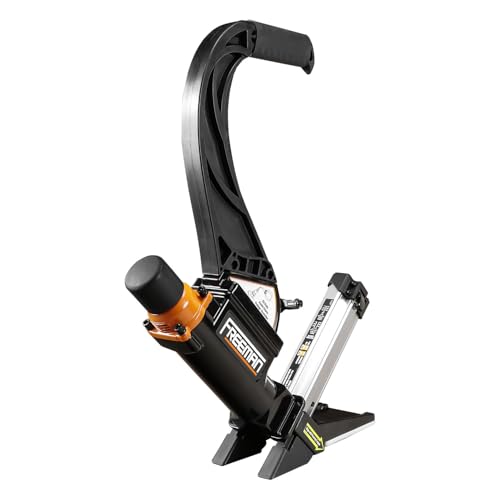
The Freeman P50LSLW offers a lightweight aluminum body with an anodized magazine and hardened steel parts, providing durability for light- to medium-duty flooring projects. It handles 16-gauge L-cleats and 15.5-gauge 1/2″ crown staples from 1-1/2″ to 2″. Best for budget-conscious installers needing a reliable starter tool that still delivers solid performance on common hardwoods. A caveat is that more demanding jobs may benefit from higher-end models with larger capacity and faster cycling.
Why it’s selected: A cost-effective, durable choice for frequent, standard installations without sacrificing essential features like interchangeable base plates and dual-nail/staple operation.
Buying Guide: Key Purchase Considerations
- Flooring type and thickness: Choose a tool that supports the cleat size and staple range compatible with your boards (engineered vs. solid, thickness in inches).
- Tool versatility: If you install a mix of hardwoods, a 2-in-1 nailer/stapler or 4-in-1 option can reduce equipment needs.
- Base plates and depth adjustment: Non-marring bases protect finishes; tool-less depth adjustment ensures consistent flush seating.
- Weight and balance: Lighter tools reduce fatigue on large rooms; consider ergonomics for long sessions.
- Reload and maintenance: Aluminum magazines and straightforward reloading speed up work; avoid tools with overly complex maintenance requirements.
FAQ
- Q: What gauge nails are best for solid hardwood versus engineered wood?
A: Solid hardwood commonly uses 15.5–16 gauge cleats; engineered floors typically use similar gauges, depending on the manufacturer’s recommendations. - Q: Can I use a 2-in-1 tool for both nailing and stapling on the same project?
A: Yes, many 2-in-1 tools support both fasteners, which is convenient for varied plank types and subfloor conditions. - Q: Why are base plates important?
A: Non-marring or adjustable base plates prevent damage to finishes and ensure proper seating for different flooring thicknesses. - Q: Is a heavier nailer better for hardwood floors?
A: Weight can impact control and fatigue. Heavier tools often offer robust construction, but the right balance and ergonomics matter more for accuracy. - Q: When should I choose a 4-in-1 tool?
A: A 4-in-1 tool is beneficial when you have to work with multiple fastener types or board sizes, reducing the need to switch tools. - Q: Are there safety considerations I should follow?
A: Always wear eye protection and follow the manufacturer’s safety guidance, including proper air pressure, depth settings, and handling to avoid ricochet injuries.