
Finding the right ground rack for solar panels involves assessing load capacity, adjustability, and long-term stability. The products below cover a range of sizes, from compact multi-piece systems to large-scale installations suitable for sheds, cabins, and open spaces. Each option emphasizes strong adaptability, weather resistance, and ease of installation to help you optimize sun exposure and performance without sagging or structural strain.
| Product | Brand | Notes | Image |
|---|---|---|---|
| ECO-WORTHY Upgraded Ground Mount | ECO-WORTHY | Large-scale, adaptable, up to 160 lbs; 30–60° adjustable |  |
| ECO-WORTHY Ground Mount System (Large Scale) | ECO-WORTHY | Supports multiple panels; robust triangular frame; 330 lbs capacity | 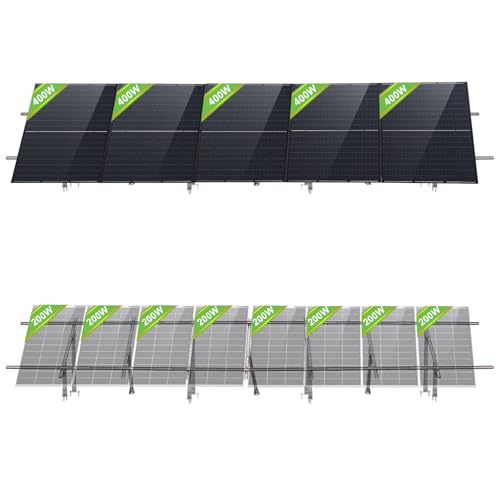 |
| 2 Sets Tilt Mount Brackets | FAHKNS | Adjustable 14–27″ support, 15–30° tilt; aluminum, 220 lbs |  |
| Moxweyeni 58 Inch Adjustable Mount | Moxweyeni | Ground/Roof/RV/Off-Grid versatility; rust-resistant aluminum |  |
| Voltset Solar Panel Mount Stand | Voltset | 0–60° tilt; 200W compatibility; immortall steel build |  |
Product Sections
style=”display:none;”>Introduction to Featured Products
ECO-WORTHY Upgraded Ground Mount
The ECO-WORTHY Upgraded Ground Mount is designed for flexibility in multi-panel setups. It features front and rear pillars with elevated vertical spacing to better support large solar panels and reduce sag. The system supports up to 160 lbs in the mid-span area and includes an upgraded middle support rod to enhance stability. Adjustable hole positions enable tilt angles between 30° and 60°, maximizing solar absorption and energy capture for various sites, from backyards to off-grid cabins.
ECO-WORTHY Ground Mount for Large Installations
This larger ECO-WORTHY ground mount system is built for sites requiring multiple 400W or 300W panels. Its front/rear pillars are notably tall, enabling robust support for larger modules. The design emphasizes a strong triangular load path to improve stability and load-bearing performance. Seven preset angles, plus adjustable hole positions, help installers optimize sun exposure across different seasons and latitudes.
FAHKNS 2 Sets Tilt Mount Brackets
FAHKNS offers a versatile mounting system for flat roofs, garages, and other horizontal surfaces. The brackets extend from 14 to 27 inches with 15–30° tilt capability and support up to 220 lbs. Made from aluminum alloy, they are designed to resist corrosion while remaining light enough for straightforward installation. The kit accommodates panels from 100W to 450W, making it a flexible choice for various solar arrays.
Moxweyeni 58 Inch Adjustable Mount
Moxweyeni provides a complete mounting kit with rails, tilt brackets, and hardware, delivering wide compatibility up to 58 inches in width. The rust-resistant aluminum construction keeps the system durable in harsh weather, while the foldable tilt legs facilitate easy transport and setup for ground, roof, RV, or offshore deployments.
Voltset Solar Panel Mount Stand
The Voltset stand emphasizes a robust 0–60° tilt range and an immortal steel construction designed for wall, roof, RV, or boat mounting. It is compatible with up to 200W panels and includes mounting rails for secure installation. The durable materials and precise adjustment options support long-term energy production in variable conditions.
Buying Guide
Key purchase considerations help tailor selection to your site and goals. Durability, weight rating, and weather resistance determine long-term performance. A system’s maximum panel size should match your planned array, while adjustable tilt angles allow seasonal optimization. For ground mounts, consider base stability—whether cement blocks or reinforced footings are included or required. Alignment accuracy and ease of maintenance are important for minimizing snags during installation and weather events.
- Compatibility: Confirm panel wattage, width, and mounting compatibility with the bracket system.
- Load capacity: Check maximum load and whether the structure can support the number of panels you plan to install.
- Adjustability: Evaluate tilt range and adjustable holes or scales for precise sun tracking.
- Durability: Look for corrosion-resistant materials (aluminum, stainless steel) and weatherproof coatings.
- Installation: Consider whether the system requires cement blocks or heavy footings and whether professional help is advisable.
For site-specific considerations, compare the five options above on: panel compatibility, mounting height, required tools, and overall footprint. Larger installations favor multi-panel systems with robust triangular frames and higher load-bearing ratings. Smaller or portable setups benefit from adjustable tilt stands with easy transport. Always ensure that installation complies with local codes and, if needed, consult a professional to optimize safety and performance.