
Choosing the right ground-mounted solar solution depends on capacity, stability, and ease of installation. This guide highlights five top options that blend durability, adaptability, and cost-effectiveness for large, open installations, cabins, farms, and remote sheds. Each entry includes practical details to help compare performance, mounting flexibility, and suitability for your site.
| Product | Brand | Key Benefit |
|---|---|---|
| ECO-WORTHY Upgraded Solar Ground Mount Brackets | ECO-WORTHY | Large-panel support with 30–60° adjustable angles |
| ECO-WORTHY Ground Mount Brackets System (5x400W/6x300W) | ECO-WORTHY | High-load stability for big installations |
| Renogy 400W ShadowFlux Panels | Renogy | Anti-shading tech and high efficiency |
| Koroao Ground Stake Mount | Koroao | Versatile ground-stake compatibility for cameras and panels |
| PT Squared Ground Mount Top Bracket | PT Squared Trading Co. | Universal bolt-on pipe compatibility and tilt control |
ECO-WORTHY Upgraded Ground Mount Brackets Kit

The ECO-WORTHY mounting kit features a robust, adjustable frame designed for multiple panel configurations. With front and rear pillars positioned to optimize load-bearing, the system can support larger panels while reducing sag and mid-span stress. The brackets offer adjustable hole positions and support a range of tilt angles, typically between 30° and 60°, to maximize sun exposure across seasons. The kit is suitable for homes, farms, cabins, and off-grid sites, providing a stable base for 4x200W, 3x300W, or 2x400W arrangements. A critical benefit is enhanced stability under heavy loads, addressing common concerns about mid-panel sag in large installations.
ECO-WORTHY Ground Mount Brackets System For Large Installations
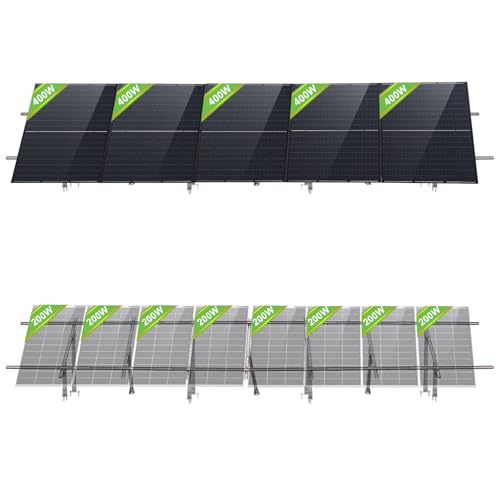
This ground mount system is designed for scalability, supporting five-by-four hundred-watt panels or multiple 300W and 200W modules. The structure emphasizes a stable, multi-triangular build to enhance load-bearing performance and prevent sag. The columns are spaced to allow easy maintenance and secure anchoring with concrete blocks as needed. Seven preset tilt angles (30°–60°) improve sunlight capture and energy production. The assembly aims to balance ease of installation with long-term durability for sites like large residences, agricultural properties, and off-grid homesteads.
Renogy 400W ShadowFlux Anti-Shading Panels (2-Pack)

Renogy’s 400W ShadowFlux panels feature anti-shading technology to reduce hot spots and maintain consistent power output in partially shaded conditions. The N-Type cell design with 16BB technology delivers up to 25% efficiency, improving energy production while extending panel lifespan. These panels are described as compact and lightweight for easier installation in space-constrained sites. Their shading mitigation and robust construction make them well-suited for RVs, marine rooftops, and larger solar arrays on farms or sheds, where shading from nearby structures or vegetation is a concern.
Koroao Ground Stake Mount For Cameras And Panels

The Koroao ground stake mount provides universal compatibility with solar panels and a variety of security cameras (Ring, Blink, Arlo, Wyze, Google Nest, Simplisafe). Its black stake design is suitable for installation in grassy or patchy ground, meadows, or landscaped yards. The height is adjustable to fit different mounting heights, helping stabilize gear and protect components from weather exposure. This option is useful when you need a versatile mount that doubles as a camera or sensor platform while keeping a solar array in a convenient, low-profile footprint.
Solar Panel Array Top Bracket For Pipe Mounts

This top bracket is designed to fit 2″–3″ pipes and supports multiple large panels, including three 400W modules or several 100W units. It is fully adjustable for optimal sun angle and tilt, and it’s sold as a mounting kit with optional bundles that include struts and clamps. Constructed from galvanized steel, it emphasizes durability in outdoor conditions and provides a secure bolt-on solution for permanent solar arrays on ground pedestals, farms, or sheds. This option is ideal when you need a solid, scalable mounting platform that can be adapted to pipe-based systems.
Buying Guide: Key Purchase Considerations
- Site conditions: Evaluate ground stability, soil type, and potential for soil movement or erosion. Ground mounts require solid anchoring and, in some cases, concrete footings.
- Panel compatibility and capacity: Confirm the mounting system supports your panel count and sizes (e.g., 200W–400W modules). Consider expandability for future upgrades.
- Tilt adjustability and sun exposure: Look for adjustable tilt ranges (commonly 30°–60°) to optimize seasonal sun angles and shading mitigation.
- Structural integrity: Prioritize designs with reinforced frames, sturdy pillars, and resistance to wind uplift and snow loads typical for your location.
- Ease of installation: Consider ease of assembly, included hardware, and whether you’ll require professional installation or can complete it with basic tools.
- Longevity and materials: Favor corrosion-resistant materials (galvanized steel, powder-coated components) for outdoor durability.
- Maintenance and access: Choose layouts that allow easy cleaning, inspection, and panel replacement without disassembling the entire system.
- Budget and scalability: Balance upfront costs with future expansion needs; modular kits may offer incremental growth options.
- Safety and compliance: Ensure grounding, wiring, and mounting practices meet local electrical codes and safety standards.
These options emphasize stability, adaptability, and efficiency across varied ground conditions. When selecting a ground-mounted system, tailor the choice to your installation scale, terrain, panel sizes, and long-term energy goals. The right setup will maximize sun exposure, minimize maintenance, and support reliable, long-term solar power generation.