
Discover top grid-tie inverters that combine solar harvesting with battery backup options for reliable home power. The selections below cover high-capacity systems, durable micro inverters, and versatile hybrids that blend solar, battery, and grid energy. Each product is evaluated on MPPT efficiency, integration options, and suitability for households, backups, or off-grid readiness. Use the Buying Guide at the end to compare features and find the right fit for your energy goals.
| Product | Brand | Key Benefit | Power Range |
|---|---|---|---|
| POWLAND 12000W Grid-Tied Hybrid Solar Inverter | POWLAND | High-capacity, battery-free design with grid backfeed option | 12,000W (120V/240V split) |
| ECO-WORTHY SL3500 | ECO-WORTHY | Stackable, expandable storage with BMS protection | 3500W (5.12 kWh, expandable to 15.36 kWh) |
| Anjfylque Hybrid Solar Inverter 3000W | Anjfylque | Battery-supported with multiple output priority modes | 3000W |
| IOENC 700W Grid Tie Inverter | IOENC | IP65 waterproof micro-inverter with reverse power transmission | 700W |
| Marsrock 1300W MPPT Grid-Tie Micro Inverter | Marsrock | Compact, efficient MPPT with pure sine output | 1300W |
POWLAND 12000W Grid-Tied Hybrid Solar Inverter

Powerful 12,000W pure sine wave output supports heavy household loads such as central air, refrigerators, and tools. This unit features a battery-free design that feeds excess solar energy into the home or grid (with optional CT sensor), potentially reducing battery costs by up to 40%. It blends solar, grid, and optional battery inputs to prioritize continuous operation for critical loads, even during sunny days with high energy consumption. The MPPT controller handles wide DC input ranges (90-500V) for robust solar harvesting and claims ultra-high efficiency for improved harvest at dawn and dusk.
Key considerations: It is designed for large homes and RV parks, offering anti-backflow when connected to the grid. While battery-free by design, it offers grid-boosting capabilities and solar-first operation, making it a strong option for users seeking high power without immediate battery investments. When pairing with batteries, ensure compatibility and proper setup with local codes and installation standards.
1400W Solar Grid Tie Inverter Microinverter

Note: This product is a microinverter with high efficiency and digital control, featuring isolated high-frequency transformer design and a 32-bit digital signal processor. It advertises efficiency above 99% and advanced MPPT-like functionality for rapid response to changing sunlight, enabling stable operation for distributed PV systems. The unit emphasizes robust digital control, anti-interference performance, and a compact form factor, making it suitable for multi-panel installations in constrained spaces.
ECO-WORTHY SL3500 Stackable Power Station

The SL3500 combines solar-ready inverter capability with a large LiFePO4 battery bank and BMS protection. It is designed for portability and expansion, allowing parallel stacking and phase separation for higher power applications. It includes a 50A BMS, fire-safe metal casing, and modular expansion to meet longer backup needs. This makes it suitable for home backup, small business continuity, or outdoor operations where a modular energy storage solution is advantageous. It supports multi-scenario use and rapid deployment during emergencies.
Marsrock 1300W MPPT Pure Sine Wave Grid-Tie Micro Inverter
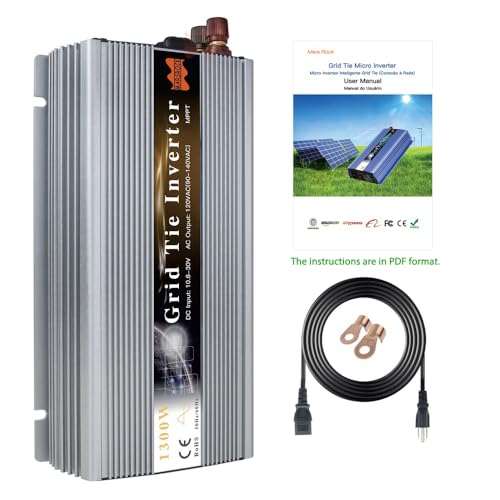
This compact unit provides 1300W of pure sine wave output with advanced MPPT to maximize panel efficiency. It emphasizes high-quality sine wave output suitable for sensitive electronics and robust anti-interference design. The small footprint and modular approach allow for scalable solar installations, particularly in residential settings where multiple units can be deployed to cover larger loads with reliable grid-ted energy.
IOENC 700W Grid Tie Inverter

This 700W grid-tie inverter highlights full digital control for strong anti-interference performance and efficient reverse power transmission. It features environmentally friendly operation by converting solar DC to grid-ready AC with complete input-output isolation for system safety. The device prioritizes efficient distribution of power and can be a practical choice for smaller solar arrays or supplementary PV setups where space and budget constraints exist.
Hybrid Solar Inverter 3000W

This 3000W hybrid inverter supports 24V DC to 110V AC with a built-in 100A MPPT charger and a wide PV input range. It enables Battery Power Mode for standard operation and a No-Battery Mode for loads when PV is sufficient. It offers four priority modes (UTL, SOL, SBU, SUB) to optimize whether the system relies on solar, battery, or the grid. This flexibility makes it a robust choice for mixed-energy setups that require adaptive load management and resilient backup capabilities.
Buying Guide: Key Purchase Considerations
- System goals: Decide whether you need pure grid-tie with backfeed, a true hybrid with battery backup, or a modular microinverter approach for scalability.
- Power capacity: Match inverter wattage to your typical load. Large homes may favor 6-12 kW or higher, while smaller setups can work with 700W-3.5 kW units.
- Battery integration: Confirm compatibility with LiFePO4 or lead-acid batteries, and verify BMS compatibility and safety features before pairing.
- MPPT efficiency: Look for high MPPT efficiency and wide input voltage ranges to maximize solar harvest, especially during dawn and dusk.
- Grid interaction: Check anti-backflow, reverse power transmission, and local electrical codes for grid-tied configurations. Ensure proper interconnection with the utility and safety requirements.
- Expansion and modulations: For expandable systems, evaluate whether the unit supports paralleled operation, stacked storage, or multiple output modes to suit future needs.
- Durability and safety: Consider enclosure type (IP ratings for outdoor use), temperature tolerance, and protective features such as overcharge, short-circuit, and thermal protection.
- Installation considerations: Evaluate weight, mounting options, ventilation, and ease of wiring. Professional installation is advised for high-wattage or utility-interfacing systems.
- Cost and lifecycle: Weigh initial cost against long-term savings from improved efficiency and reduced grid dependency. Battery-backed systems may offer better resilience during outages but require maintenance and replacement cycles.
- Warranty and support: Favor products with solid manufacturer support and clear warranty terms to protect your investment over time.