
Marine-grade flexible solar panels offer light weight, curved-surface installation, and strong performance for boats, RVs, and other watercraft. This guide highlights five top picks that balance efficiency, durability, and ease of installation on curved surfaces. Each option is designed to withstand harsh marine environments while delivering reliable power on sunny days. Read on to compare capabilities, installation notes, and what to consider before buying.
| Product | Brand | Watts | Notes |
|---|---|---|---|
| Renogy 200W Flexible Panel | Renogy | 200W | High-power, 240° bend, lightweight |
| Renogy 100W Flexible Panel | Renogy | 100W | Lightweight, bendable up to 240° |
| Topunive 100W Flexible Panel | Topunive | 100W | 9BB cells, flexible, versatile mounting |
| BougeRV Arch Pro 200W | BougeRV | 200W | N-Type, high shading resistance |
| ECO-WORTHY 2x130W Panels | ECO-WORTHY | 260W (paired) | High efficiency, curved-surface ready |
Renogy 200W Flexible Solar Panel

The Renogy 200W flexible solar panel is designed for curved surfaces common on boats and RVs. It provides a high power output, with estimates of around 1000 Watt-hours per day under optimal sun conditions (5 hours of sun). Its ultra-lightweight construction reduces load on marine mounts, and its 240-degree bendability allows installation on rounded roofs or hatches. The panel uses half-cut PERC cell technology to boost light capture and electrical performance, delivering improved efficiency in variable marine lighting. This combination makes it a strong option for users prioritizing power density and flexible mounting on vessels.
Renogy 100W Flexible Solar Panel
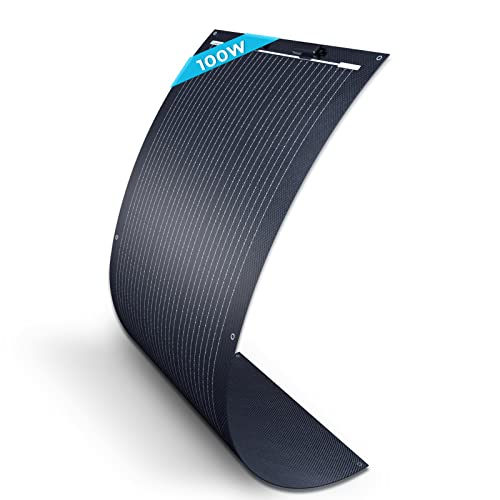
The Renogy 100W flexible panel is built for curved surfaces and portability, bending up to 240 degrees while remaining significantly lighter than rigid panels. It delivers an approximate 500 Watt-hours daily output under favorable sun, making it a practical balance of size and performance for smaller boats or auxiliary power needs. The panel employs half-cut PERC cell tech to maximize efficiency and minimize losses in bright or patchy marine light conditions. It’s a compact option for reliable daytime charging with straightforward installation.
Topunive 100W Flexible Solar Panel

Topunive’s 100W flexible panel is optimized for irregular surfaces and marine applications. It features a minimal radius bend with a compact footprint, allowing mounting on curved decks or cabin roofs where rigid panels won’t fit. Weighing around 2 kg, it’s easy to transport and install. The panel uses 9BB (nine busbars) monocrystalline cells, which enhances conversion efficiency up to approximately 23%. Its flexible design, modular busbar structure, and lightweight form support swift, clutter-free installation on boats and trailers alike.
BougeRV Arch Pro 200W Flexible Panel

BougeRV Arch Pro 200W is designed for stable output with enhanced shading tolerance. The panel uses an N-Type, 16BB cell configuration to achieve high efficiency and a 25% conversion rate. It includes upgraded bypass diode technology to mitigate hot-spot damage and maintain energy delivery under partial shading or low-light conditions, common in marina environments. Its flexible, fiberglass-reinforced construction supports longer lifespans and the possibility of wiring in series to charge 12V, 24V, or 48V systems. This panel is suitable for extended marine use where reliability matters most.
ECO-WORTHY 2x130W Flexible Panels

The ECO-WORTHY set comprises two 130W flexible panels that collectively deliver up to 260W of flexible solar capacity. They are designed for curved or irregular surfaces on boats or RVs and promise a notable daily energy yield with four hours of full sun. The panels emphasize high flexibility and lightweight installation, with robust pre-drilled mounting holes and adaptable attachment options. The 23.5% efficiency rating supports meaningful power generation in variable marine daylight conditions, making them a compelling option for those needing substantial flexible solar capacity on curved surfaces.
Buying Guide
- Surface fit and mounting: Flexible panels excel on curved or irregular surfaces. Confirm the panel’s bend radius and mounting options to ensure it fits your vessel’s hull or roof without compromising waterproofing.
- Cell technology and efficiency: Look for half-cut PERC or 9BB monocrystalline cells for higher efficiency and better performance in partial shade or lower light conditions commonly found at sea.
- Weight and handling: Marine setups benefit from lightweight panels to minimize load. Compare weights and easy-install features such as pre-drilled holes or adhesive-friendly edges.
- Durability and protection: Panels with strong laminates, ETFE covers, and fiberglass reinforcement tend to resist impact and weathering. Check certifications and warranty terms where available.
- System integration: Consider how the panel’s voltage and current lines integrate with existing charge controllers and battery banks. Flexibility for 12V, 24V, or 48V configurations can influence long-term usability.
- Shading tolerance: Boats experience partial shading from masts or rigging. Panels with bypass diodes or shading mitigation provide steadier output under non-ideal conditions.
- Durability vs. flexibility trade-off: Extremely flexible panels are easier to install on curved surfaces but may have slightly lower peak efficiency than rigid or semi-rigid options. Balance weight, durability, and energy needs accordingly.
- Maintenance and longevity: Choose panels with longer service life and resistance to salt spray, humidity, and UV exposure. Regular inspection of wiring and seals extends system reliability.