
When securing your property’s perimeter, a reliable driveway motion sensor system can be a smart, proactive solution. The following selections emphasize long range, weatherproof design, easy installation, and flexible alert options to fit homes, small businesses, and outdoor spaces. Each model below includes a weather-resistant sensor, a plug-in or rechargeable receiver, and adjustable detection to minimize false alarms while maximizing situational awareness.
Summary of selected products:
| Product | Brand | Key Features (highlights) | Range & Coverage | Link |
|---|---|---|---|---|
| Driveway Alarm—1/2 Mile Long Range | HTZSAFE | Weatherproof, dual sensor, 50 ft detection, 2 sensors | Up to 1/2 mile wireless | HTZSAFE Product |
| 1byone Driveway Alarm with 2 Sensors | 1byone | 36 chimes, 1000 ft range, PIR motion detection | Up to 1000 ft | 1byone (First) |
| 1byone Driveway Alarm with 1 Receiver | 1byone | 3 alert modes, 1000 ft range, weatherproof sensors | Up to 1000 ft | 1byone (Second) |
| eMACROS 1/2 Mile Solar Driveway Alarm | eMACROS | Solar powered, expandable to 4 sensors, 1500 ft range | Up to 1500 ft | eMACROS |
| Wireless Driveway Alarm—600 ft Range | Bistee | 600 ft wireless, 2 sensors, 20 ft detection | Up to 600 ft | Bistee |
Driveway Alarm—HTZSAFE (1 Receiver, 2 Sensors)

HTZSAFE’s wireless driveway alarm is designed for robust outdoor monitoring with weather resistance suitable for driveways, porches, gates, pools, and garages. The system includes 1 receiver and 2 motion sensors, offering a practical two-sensor approach for perimeter coverage. Its sensors operate across a wide temperature range, from extreme cold to heat, ensuring year-round performance. The 1/2 mile wireless transmission range helps cover larger properties, while the adjustable detection range (35–50 feet) and dual sensitivities help tailor alerts to avoid false alarms from debris, wind, or sun glare.
Key considerations include the system’s reliance on wireless transmission technology (FSK+FHSS) to minimize interference and its flexible placement across indoor and outdoor spaces. When deploying, consider line-of-sight and potential obstacles, and place sensors where heat signatures from people or vehicles are most distinguishable. The HTZSAFE model is a strong pick for homeowners seeking a straightforward, expandable perimeter alert with reliable range and weather resistance.
1byone Driveway Alarm with 2 Sensors
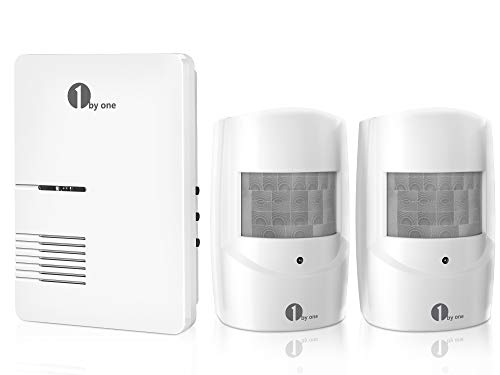
1byone’s system emphasizes long-range wireless communication and a variety of alert options. With 1000 feet of range between sensors and the receiver, users can monitor larger perimeters. The system supports detection up to 24 feet from each sensor, capturing activity along driveways and walkways. It offers thirty-six chime options and three alert modes (sound, LED flash, or both), with adjustable volume levels from 25 to 80 dB. This makes it suitable for busy homes or offices that benefit from distinct notification cues or family-wide alerts without continuous noise.
Considerations include ensuring the chosen chime and alert method fit the property’s noise tolerance and that installation locations optimize the sensor’s PIR detection to avoid blind spots. The ability to differentiate alerts—through different chimes or LED indicators—can help prioritize responses and improve security awareness on multi-property sites.
1byone Driveway Alarm with 1 Receiver

This 1byone configuration emphasizes reliable long-distance reach with a single receiver while maintaining multiple alert options. The two weatherproof PIR sensors expand detection coverage to driveways, gates, front porches, or other entry points. It supports three alert modes and multiple chimes, enabling homeowners to tailor notifications to different zones. The 24-foot detection range per sensor helps cover nearby entryways effectively, making it a practical choice for properties with several access points or a larger footprint where a single receiver might suffice for central monitoring.
When choosing this setup, consider whether you need more than one receiver for broader coverage, or if a single receiver suffices for your property layout. The system’s modular nature makes it easy to scale later by adding more sensors or receivers as needed.
eMACROS Solar Driveway Alarm System

eMACROS presents a solar-powered driveway alarm system designed for perpetual operation with minimal maintenance. The system supports expansion to up to four sensors and unlimited receivers, providing scalability for larger properties. Its 1500-foot wireless range is notable for real-world scenarios with foliage or structures that can hinder signals. The product emphasizes false alarm reduction through modern PIR technology and software algorithms, while offering a straightforward setup with quick-start guidance. A key draw is the solar panel that backs a rechargeable battery, potentially delivering up to 24 months of operation on a full charge.
Considerations include the need for ample sun exposure to keep the solar panel charging efficiently and ensuring the sensors’ placement minimizes interference from dense vegetation or thick walls. The expanded scalability makes this option attractive for growing security needs across larger properties or multi-building layouts.
Bistee Wireless Driveway Alarm System

The Bistee system provides a compact, practical option with one receiver and two sensors, delivering a 600-foot wireless range and a 20-foot detection reach. This setup suits smaller properties or budgets while still offering modern wireless transmission with FSK+FHSS to reduce interference. The 600-foot range is typically sufficient for many driveways and adjacent spaces, and the dual-sensor arrangement helps blanket entry points without complexity. The system’s straightforward installation and robust weatherproofing (IP-rated) can appeal to homeowners who want reliable monitoring without extensive setup work.
In choosing this option, consider whether the shorter range is a constraint for larger properties or if this model’s simplicity and cost-effectiveness better match your security goals. The two-sensor approach remains useful for monitoring adjacent entry points with minimal overlap and clear alert separation.
Buying Guide: Key Purchase Considerations and Comparisons
- Range and coverage: Evaluate the property size and layout. Open, unobstructed spaces permit longer ranges (up to 1500 ft in some models), while fenced or wooded areas may reduce range. Consider whether you need a single central receiver or multiple receivers to cover multiple zones.
- Sensor technology: Most systems use Passive Infrared (PIR) sensors, which detect heat signatures. PIR sensors work well for people and vehicles, but leaf movement or small animals can cause false alarms. Look for systems with adjustable sensitivity and anti-false-alarm features.
- Weatherproofing and durability: For outdoor deployment, ensure sensors have weather-resistant enclosures (IP ratings like IP44 or IP65) and operate across a wide temperature range. UV resistance and corrosion protection extend life in harsh climates.
- Power and maintenance: Solar-powered sensors offer long-term independence but require sun exposure and occasional cleaning of panels. Plug-in receivers simplify power needs but require nearby outlets. Check whether adapters, batteries, or charging options are included or available.
- Alerts and customization: The ability to differentiate zones using multiple chimes, LED indicators, and adjustable volume helps tailor alerts to different areas or times of day. Some systems also support multiple receivers for broader coverage.
- Expandability: If you plan to scale, choose a system that accepts additional sensors or multiple receivers. Modular designs reduce the need for complete replacements as security needs evolve.
- Installation and placement: Position sensors to maximize line-of-sight with minimal obstructions. A 20–50 degree detection angle is common; ensure sensors are mounted at optimal heights to capture movement reliably without triggering on wind-blown debris.
- Interference management: Look for systems employing FHSS or similar interference-reduction technologies to handle competing signals from neighboring devices.
In summary, the HTZSAFE and eMACROS options stand out for long-range capability and expandability, while 1byone models offer versatile alert customization and reliable coverage for moderate properties. The Bistee model provides a compact, budget-friendly choice for smaller driveways. When selecting, balance range, weather resilience, and expansion potential against your property size and desired alert complexity. A system that fits your layout and future security goals will deliver the most consistent performance over time.