
Answering common buyer questions, the following guide highlights the best crawl space dehumidifiers suited for basements, crawl spaces, and other damp spaces. This selection focuses on units that balance high moisture removal with practical installation features like built-in pumps, auto defrost, and compact footprints. The top picks are ideal for different space sizes and usage needs, such as industrial basements, storage areas, or homes with persistent humidity. The buyer can expect clear, comparison-friendly details to help decide which unit fits their space and drainage setup.
Summary of selected products:
- Waykar 125 Pint Crawl Space Dehumidifier with Pump & Drain Hose — best for large spaces up to 6,500 sq ft and flexible drainage.
- Airecoler 125 Pints Commercial Dehumidifier — best for industrial-grade drying in wide areas up to 6,000 sq ft.
- ALORAIR 113 Pint Commercial Dehumidifier — best for rugged crawl spaces with automatic defrost and no-tank drainage.
- ALORAIR Crawl Space/Basement Dehumidifier 70 Pint with Pump — best for smaller to mid-size spaces requiring upward drainage.
- Aiusevo 75 Pints Crawl Space Dehumidifier with Pump — best for larger crawl spaces up to 5,200 sq ft with smart controls.
Waykar 125 Pint Crawl Space Dehumidifier with Pump & Drain Hose

Best for large crawl spaces that require flexible drainage. This unit delivers up to 125 pints per day and handles spaces up to 6,500 sq ft. It includes a 16.4 ft pump drainage hose and a separate gravity drain option, enabling vertical drainage and long-distance discharge. A rotary compressor boosts efficiency while offering lower energy use. It’s well-suited for commercial or industrial spaces, garages, and storage areas where door openings and high humidity are ongoing concerns. A potential limitation is the need for vertical or long-distance drainage to maximize the pump’s effectiveness.
Who it’s best for: facilities needing robust moisture removal with flexible drainage options and a higher ceiling on space coverage. Why chosen: strong dehumidification with pump drainage is ideal for unheated spaces or setups where gravity drainage isn’t convenient.
Airecoler 125 Pints Commercial Dehumidifier
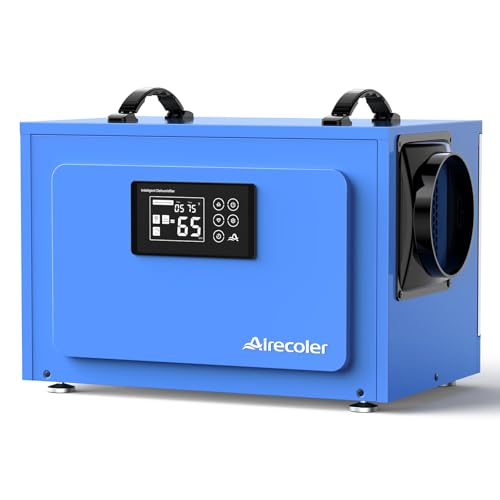
Best for expansive damp areas like crawl spaces and basements in industrial environments. This dehumidifier can extract up to 125 pints daily (Max.) and 60 pints AHAM, using an energy-efficient R32 system and a 24-hour auto ON/OFF timer. Its compact footprint (19.2 x 12.2 x 13.4 inches) allows placement in tight crawl spaces or suspended between joists. It suits commercial or warehouse settings that require reliable moisture control with energy-conscious operation. Limitation: smaller auto-defrost indicators may be less responsive in very cold conditions without monitoring.
Who it’s best for: businesses or homeowners needing a compact, high-capacity dehumidifier for large damp areas. Why chosen: industrial-grade performance in a relatively compact form factor with energy-saving features.
ALORAIR 113 Pint Commercial Dehumidifier

Best for crawl spaces that demand rugged construction and reliable automatic defrost. The 113-pint capacity at saturation (53 pints AHAM) handles up to 1,200 sq ft. It uses a metal casing designed for tough environments and includes a MERV-1 filter to protect internals from dust. Automatic defrost helps prevent frost buildup in cooler spaces, conserving energy and extending unit life. A notable caveat: higher initial power consumption in fully loaded conditions may occur compared with smaller models.
Who it’s best for: installations in dusty, rugged crawl spaces or basements where a durable unit is preferred. Why chosen: metal housing and auto-defrost improve longevity in demanding environments.
ALORAIR Crawl Space/Basement Dehumidifier (70 Pint) With Pump

Best for mid-size crawl spaces needing upward drainage. This unit handles up to 70 pints per day under saturated conditions and supports drainage via a built-in condensate pump that lifts water up to 19.6 ft. It includes gravity drainage as well, enabling flexible installation even in spaces with limited floor drains. The auto defrost feature helps maintain operation in cooler environments. Limitation: AHAM performance is lower, so choose this if space is under 1,000 sq ft and power efficiency is a priority.
Who it’s best for: homeowners or contractors working in smaller crawl spaces or basements with challenging drainage. Why chosen: versatile two-way drainage and compact form factor suit tight installations.
Aiusevo 75 Pints Crawl Space Dehumidifier With Pump

Best for large crawl spaces up to 5,200 sq ft and spaces needing smart control. This 75-pint model uses a high-airflow design (up to 200 CFM) and supports dual drainage options: gravity drainage with a 6.6 ft hose or pump drainage with a 16.4 ft hose. It offers a touchscreen control, auto-restart after power outages, and a compact footprint (approximately 16.5″ x 13.7″ x 12.5″). Limitation: may be overpowered for very small crawl spaces, resulting in faster humidity cycling.
Buying Guide
What size should you choose? Start with the space size and current humidity. For spaces up to 1,000 sq ft, units around 70–113 pints per day can suffice. For larger crawl spaces (2,000–6,500 sq ft), prefer 125 pints or higher and consider models with a built-in pump to handle long-distance drainage.
What drainage option matters? If gravity drainage is feasible, a unit with a gravity hose is simple and inexpensive. If the space is hard to reach or at a higher level, a pump drainage option is essential to avoid manual emptying and to vent water to a sink or exterior outlet.
Do you need auto defrost? Yes, if the crawl space experiences cool temperatures or frequent dew-point fluctuations. Auto defrost prevents coil icing and maintains continuous operation in low-temperature environments.
Is energy efficiency a factor? Look for units with energy-saving features like variable speed fans, energy Star ratings, and modern refrigerants (such as R32). These features reduce running costs over long remediation projects.
What about installation and maintenance? A compact footprint helps in tight crawl spaces. Units with a drain hose and accessible condensate paths reduce maintenance time. A built-in filter and sturdy casing improve longevity in dusty environments.
FAQ
What size dehumidifier do I need for my crawl space?
Assess the space area (sq ft) and typical humidity. For up to 1,000 sq ft, 70–113 pints per day is common. For larger spaces, 125 pints or more with pump drainage is advisable.
Is a pump drainage unit better than gravity drainage?
Yes if the space has limited drainage access or is elevated. A pump allows vertical lifting and long-distance discharge beyond gravity limits.
Do I need auto defrost?
Recommended for cool or damp environments to prevent coil icing and ensure uninterrupted operation.
How important is energy efficiency?
Energy efficiency reduces operational costs during long drying projects and improves long-term reliability.
Can these units be used in basements and garages?
Yes. The selected models are designed to handle damp basements, crawl spaces, and similar spaces, with features to manage dust, odors, and humidity levels.