
CoreXY 3D printers are designed for high-speed, precise movement, making them ideal for rapid prototyping and multi-color projects. This guide highlights five top CoreXY machines suited for different buyers—from beginners seeking auto leveling to seasoned makers needing high-temperature capabilities and multi-color printing. Each option is evaluated for who it’s best for and why, with clear, practical buying guidance.
Summary Table of Selected Models
| Product | Best For | Build Volume | Key Strength | Auto Leveling / Calibration |
|---|---|---|---|---|
| FLASHFORGE Adventurer 5M | Rapid prototyping teams | 220 x 220 x 220 mm | Ultra-high speed and detachable nozzle | Yes (One-Click Automatic Printing) |
| ELEGOO Centauri Carbon | Advanced enthusiasts | 256 x 256 x 256 mm | High-temp nozzle; built-in camera | Yes (Auto Calibration) |
| FLASHFORGE AD5X | Multi-color projects | 220 x 220 x 220 mm | Multi-color capability; 12x speed | Yes (1-Click Auto Leveling) |
| FLASHFORGE AD5M | High-speed, reliable printing | 220 x 220 x 220 mm | CoreXY with 600 mm/s speed | Yes (Auto Leveling) |
| Creality K2 Combo (A) | Multicolor versatility | 260 x 260 x 260 mm | 4-color CFS system integration | Auto Leveling & Smart RFID |
FLASHFORGE Adventurer 5M 3D Printer

The Adventurer 5M is a CoreXY-based system with a fully automatic leveling feature and a high-temperature direct extruder. It is best for teams or individuals who prioritize fast first-layer reliability and rapid cycle times. The 600 mm/s travel speed and 20000 mm/s² acceleration support rapid prototyping, while the detachable nozzle design enables quick swaps for diverse materials.
Who it’s best for: small studios, engineering teams, and hobbyists who need speed with reliable auto-leveling. Why selected: it combines ease of use with aggressive speed and a robust all-metal frame. Caution: high-speed printing can amplify resonance; ensure proper bed anchoring and ambient stability to minimize vibrations.
ELEGOO Centauri Carbon 3D Printer
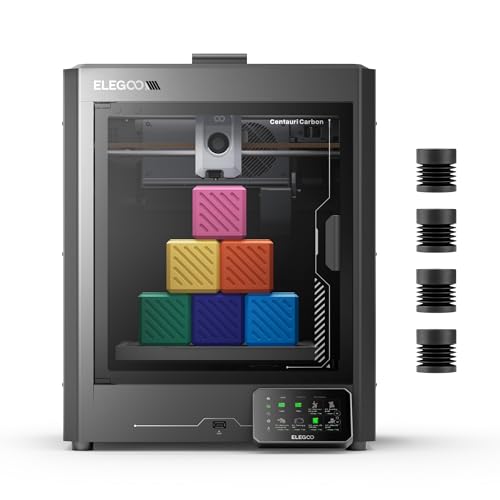
The Centauri Carbon is built around a CoreXY architecture designed for up to 500 mm/s printing, paired with auto calibration and a high-temperature nozzle. Its enclosed chamber and built-in camera help monitor prints remotely, making it a strong pick for users expanding into advanced materials and larger prints.
Who it’s best for: intermediate to advanced users who want fast performance and monitoring capabilities. Why selected: out-of-the-box readiness with auto-leveling simplifies setup; best for users who value speed with reliable process visibility. Caution: large prints in a small workspace can be challenging; plan enclosure and ventilation accordingly.
FLASHFORGE AD5X Multi-Color Printer

The AD5X specializes in vivid multi-color printing with support for up to four colors simultaneously. It also features a 1-click auto leveling for consistent first layers and a stable CoreXY design capable of up to 600 mm/s with high acceleration. Best for multi-color prototypes and visually-driven projects.
Who it’s best for: designers and makers who need quick color changes without filament swapping delays. Why selected: best-in-class color handling at speed within a compact build. Caution: multi-color workflows can require careful filament management to prevent tangling and color-mingling artifacts.
FLASHFORGE AD5M 3D Printer

The AD5M emphasizes high-speed CoreXY printing with 600 mm/s capabilities and a fully automatic leveling system for a flawless first layer. It ships with a high-temp direct-drive extruder and a quick-swap nozzle, supporting precise prints across a range of materials.
Who it’s best for: fast-turnaround prototyping teams and professionals needing repeatable first layers. Why selected: combination of speed, auto-calibration, and flexible nozzle options. Caution: ensure power stability and proper cooling, as sustained high-speed runs generate heat and mechanical loads.
Creality K2 Combo (A) 3D Printer

The Creality K2 Combo offers multicolor printing via the CFS system, with a 260 x 260 x 260 mm build volume and smart RFID filament recognition. Auto leveling and pre-assembly speed setup are highlighted, making it approachable for those who want fewer initial steps.
Who it’s best for: users seeking color versatility without extensive assembly. Why selected: strong multicolor capability and smart filament management. Caution: the CFS ecosystem may require compatible modules for full 16-color potential, which can add complexity for first-time setups.
Buying Guide — Core considerations for CoreXY 3D Printers
- Speed vs. precision: CoreXY systems excel at high speeds but require robust frame construction to minimize vibrations. Look for rigid all-metal frames and quality linear rails or rods.
- Auto leveling and calibration: Auto bed leveling reduces setup time and improves first-layer reliability. Consider printers with integrated sensors for consistent offsets.
- Extruder and nozzle options: High-temperature direct drive extruders provide broader material compatibility. Quick-swap nozzles can save time on tool changes for different layer heights.
- Build volume: Match the build area to your typical projects. Larger volumes enable bigger prints but may require more enclosure and ventilation considerations.
- Filament handling: Multicolor printing capability is valuable for visual projects. Check filament management and the ease of changing colors or using multiple bays.
- Monitoring features: Built-in cameras or remote monitoring help track prints, especially for long jobs or busy work environments.
- Software and compatibility: Ensure compatibility with common slicers and that the printer supports your preferred materials, including carbon fiber composites when available.
- Noise and cooling: Quieter operation and efficient cooling improve user experience in shared spaces or late-night sessions.
FAQ
- What is a CoreXY 3D printer?
CoreXY is a motion system that uses two motors to drive the X and Y axes, providing high-speed, precise planar movement with reduced moving mass. - Are auto-leveling features worth it for beginners?
Yes. They simplify first-layer setup and improve print reliability, especially for users new to bed calibration. - Can CoreXY printers handle high-temperature materials?
Many models offer hotends up to 280°C or higher, enabling materials like PETG, ABS, and some carbon-fiber filaments; verify each model’s rated temperature. - Is multi-color printing practical for hobbyists?
Multi-color workflows are feasible on several CoreXY models, but require filament handling discipline and sometimes additional hardware or modules. - What should I look for in maintenance and upgrades?
Look for modular nozzle systems, accessible bed leveling, and a robust frame to simplify upgrades and component replacements.