
Greenhouse growers targeting faster growth, bigger yields, and healthier plants often rely on reliable CO2 enrichment. This guide reviews five top CO2 generators and related devices to help you maximize photosynthesis without complicated setups or high running costs. Each option below is evaluated for safety, ease of use, and effectiveness in indoor grow spaces. Use the buying guide at the end to compare features and choose what fits your greenhouse size and cultivation goals.
Summary of selected products
| Product | Type | Key Benefit |
|---|---|---|
| CO2BAG XL | Natural CO2 generator (bag) | Maintenance-free, steady CO2 for weeks |
| Inkbird ICC-510 | CO2 controller | Dual outputs with light sensor for efficiency |
| Hygger CO2 5L Kit | Advanced aquarium-style CO2 system | Motor valve for precise timing, integrated safety |
| Hygger CO2 2L Kit | CO2 system kit | High-pressure stainless construction with regulator |
| The Green Pad GP6050 | Economical backup CO2 source for tanks and grow spaces |
CO2BAG XL – Natural CO₂ Generator for Indoor Plants & Greenhouses

CO2BAG XL offers a maintenance-free approach to enriching indoor gardens. The bag releases CO2 steadily, supporting consistent photosynthesis without the need for tanks, regulators, or electricity. This makes it ideal for grow rooms and greenhouses seeking a simple, safe enrichment method. It’s designed to boost growth, yields, and color in fruiting crops, with a focus on steady, plant-friendly CO2 delivery that reduces management overhead.
Key features include: accelerated plant growth and higher yields due to a constant CO2 presence, maintenance-free operation requiring only hanging in the grow space, and safety for both plants and people through a controlled release of CO2. This option suits small to medium greenhouse setups where minimizing equipment complexity is a priority.
Inkbird ICC-510 CO2 Controller

The Inkbird ICC-510 is a dual-output CO2 controller designed for grow tents, rooms, and greenhouses. It connects to CO2 equipment and a ventilation system to maintain stable CO2 levels. Its intelligent light sensor automatically adjusts CO2 output based on ambient light, helping to conserve energy while supporting healthy plant development. A universal power supply expands compatibility for various regions. This controller suits growers who want automated CO2 management with integrated ventilation control to avoid overshoot and energy waste.
MagTool Upgraded 2.5L DIY Aquarium CO2 Generator Kit
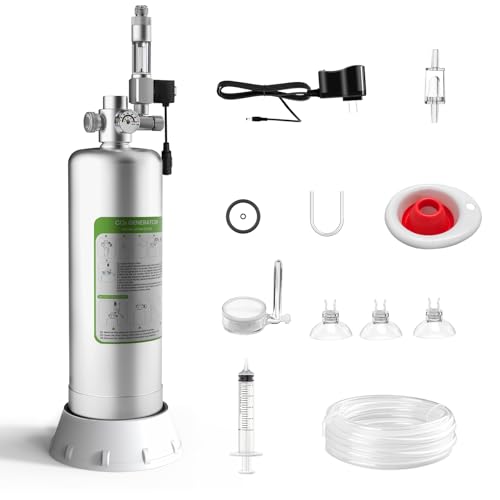
The MagTool 2025 Upgraded 2.5L CO2 generator kit combines a stainless steel bottle with an integrated solenoid, bubble counter, safety features, and a compact design. The 304 stainless steel bottle supports durability, safety, and high-pressure resistance, while the integrated solenoid and bubble counter simplify precise CO2 delivery. The kit includes a safety valve and a main switch for reliable operation. This option is well-suited for hobbyist and small-scale greenhouse setups that want precise, programmable CO2 injections in a contained system.
Hygger CO2 5L Aquarium Generator System
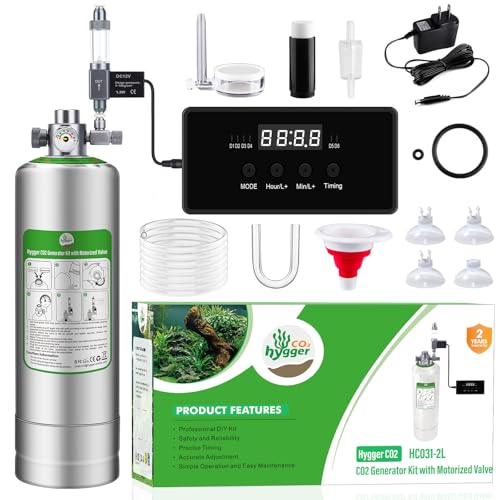
Hygger’s 5L CO2 generator kit emphasizes reliable tank-style CO2 delivery with a timer-enabled motor valve. The upgraded design features a durable 5L bottle and a compact, integrated structure that supports precise scheduling for CO2 injections. It includes safety-conscious components like a dual safety mechanism and an easy-to-use quick-release design to simplify installation and maintenance. It is suitable for larger greenhouses or planted tanks where consistent CO2 dosing and user-friendly management are prioritized.
The Green Pad GP6050 CO2 Generator Kit

The Green Pad GP6050 offers a budget-minded approach to CO2 enrichment. These CO2 generator pads are designed to supplement indoor gardens and are positioned as a backup or supplementary source for CO in grow spaces. While not a heavy-duty system, this option provides an economical means to ensure a steady CO2 supply, particularly useful as a supplementary source when tanks or other equipment are less accessible. It can help maintain CO2 levels during critical growth stages without significant upfront investment.
Buying Guide: Key considerations for choosing a greenhouse CO2 solution
When selecting a CO2 system for a greenhouse, consider the following factors to match your needs and space:
- Scale and space: Larger greenhouses typically benefit from higher CO2 capacity and robust delivery systems. For small to mid-sized spaces, compact or passive options like CO2BAG XL can be effective.
- Delivery method: Passive CO2 sources (like CO2 bags or pads) provide steady enrichment with minimal setup but limited control. Active systems (solenoids, controllers, and regulators) offer precise timing and concentration control, which can improve uniformity and efficiency in larger setups.
- Control and automation: Controllers with sensors (CO2, light, temperature) help prevent overshoot and fossil energy waste. Dual outlets and alarms add redundancy for safety and reliability.
- Safety and compliance: Ensure equipment safety features (automatic relief valves, manual shut-offs, leak prevention) and follow local guidelines for CO2 handling in enclosed spaces including proper ventilation strategies.
- Maintenance and durability: Stainless steel components, sealed connections, and high-quality regulators reduce leaks and downtime. Maintenance-free options minimize labor, but consider replacement schedules for active systems.
- Cost of operation: Passive methods have lower ongoing costs but provide limited control. Active systems require electrical power but can optimize plant growth through precise dosing and automation.
- Compatibility with greenhouse design: Consider mounting options, space for hoses or bags, and whether you need integrated venting or external fans to maintain air exchange.
In practice, growers often combine a passive CO2 source for baseline enrichment with an active controller to fine-tune levels during peak growth periods. For beginners or smaller spaces, a single CO2 source paired with a basic controller may suffice. For larger greenhouses, multiple delivery points and an automated system delivering precise ppm levels can improve uniformity and results.