
If you’re shopping for a CFM air compressor, you want steady airflow, adequate tank size, and low maintenance. This guide highlights five top options that balance power, noise, and portability for American garages and workshops. Each product targets different needs—from quiet indoor use to heavy-duty framing and painting. The buyers best suited for these units range from DIY hobbyists to professional shop setups. The table below compares the key picks at a glance.
| Product | Best For | Tank Size | Max PSI | Notes |
|---|---|---|---|---|
| Metabo HPT THE TANK | Heavy-duty framing and roofing jobs | 6 Gallon | 200 PSI | High pressure and solid airflow |
| Campbell Hausfeld 80 Gallon | Professional shop with continuous run-time | 80 Gallon | 140 PSI | Large capacity, high CFM |
| FORNAX 8 Gallon Ultra Quiet | Quiet indoor workshops | 8 Gallon | 125 PSI | Low noise, portable |
| VEVOR 13-Gallon | Versatile home and light professional use | 13 Gallon | 125 PSI | Low noise, good airflow |
| MZB 13.2 Gallon Ultra Quiet | Residential garages and paint projects | 13.2 Gallon | 115 PSI | Quiet operation, durable |
Metabo HPT THE TANK Portable Pancake Air Compressor

Best for high-pressure tasks and professionals needing power in a compact form. THE TANK delivers 200 PSI, topping many pancake models, with 4 CFM at 90 PSI. This combination supports framing, roofing, and finish work where steady airflow matters. It’s chosen for crews that require reliable bursts of pressure without a bulky footprint.
Best for: tradespeople running multiple nailers or heavier tools that demand consistent pressure. Why selected: higher max pressure and robust airflow provide more versatility in a compact package.
Caution: While powerful, the unit’s compact design may limit runtime under continuous heavy use compared to larger tanks.
Campbell Hausfeld 80 Gallon Vertical Air Compressor
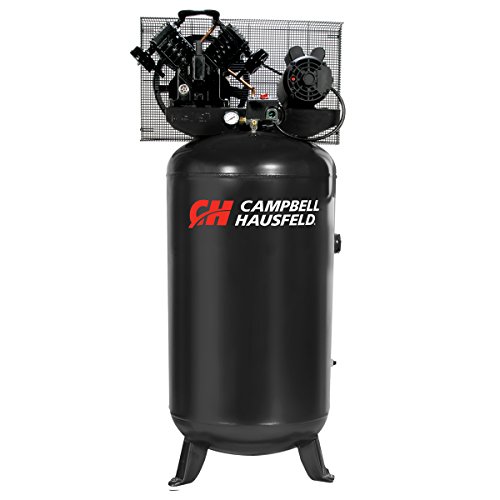
Best for professional shops needing long run times and high-volume air. This 80-gallon vertical tank supports up to 140 PSI and 16 CFM at 90 PSI, providing sustained airflow for sanding, spraying, and cutting. It’s selected for its capacity to handle multiple tools simultaneously in a workshop setting.
Best for: garages and small shops with continuous air demand. Why selected: large tank and strong CFM help minimize downtime between tool cycles.
Caution: Larger footprint means it requires more floor space and permanent placement.
FORNAX 8 Gallon Ultra Quiet Air Compressor

Best for DIY enthusiasts needing a quiet, portable unit for nail guns, tire inflation, and basic projects. The 8-gallon tank with a 1HP motor reaches 125 PSI, and the design emphasizes low noise (70 dB) and ease of transport. It’s chosen for indoor use where noise is a concern.
Best for: home workshops and light cosmetic projects. Why selected: ultra-quiet operation and portability suit apartment or garage setups.
Caution: Not ideal for continuous high-demand painting or framing tasks that require extended air supply.
VEVOR 13-Gallon Quiet Air Compressor

Best for versatile use around the home and light professional tasks. This 13-gallon model delivers around 125 PSI with 2 HP, designed for easier transport and lower noise. It’s a balanced pick where quiet operation complements portability.
Best for: DIY projects and small bodywork tasks. Why selected: combines larger tank with quiet operation and mobility.
Caution: Air delivery is solid for light-to-moderate tasks, but not ideal for heavy, continuous production work.
MZB 13.2 Gallon Ultra Quiet Air Compressor

Best for residential paint projects and indoor workshops needing quiet operation with ample air. This 13.2-gallon unit provides 115 PSI and emphasizes ultra-quiet performance around 70 dB. It’s selected for users prioritizing a calm environment without sacrificing capacity.
Best for: home garages and light spray painting. Why selected: reliable airflow at a reasonable noise level makes it suitable for indoor use.
Caution: Lower maximum PSI than some professional models, which may affect very high-demand tasks.
Buying Guide: How To Choose The Right CFM Air Compressor
- Larger tanks provide longer run times between fills, reducing cycling. For nail guns and spray painting, prioritize higher CFM at your target PSI along with tank capacity to maintain stable pressure during bursts.
- CFM at a given PSI determines tool compatibility. Check the CFM rating at the PSI you’ll actually use. Higher PSI can support more tools, but may draw more power and noise.
- Wheel kits and compact footprints improve maneuverability. Heavy-duty shop setups may justify larger, stationary tanks.
- Oil-free pumps require less maintenance and are cleaner for indoor use; oil-lubed units often last longer under heavy-duty work but need periodic oil maintenance.
- For indoor spaces and apartments, aim for 66–70 dB or lower. Quieter models are ideal for home projects and shared walls.
- A higher duty cycle supports extended tool use. Consider the tools you plan to run (nailers, spray guns, grinders) and how long you’ll operate them continuously.
- Verify your outlet voltage (120V is standard in many homes) and available space for the unit and its exhaust.
FAQ
- What is CFM and why does it matter? CFM measures air volume at a given pressure. It determines whether your compressor can sustain multiple tools or fast-action tasks without dropping pressure.
- Is a larger tank always better? Not always. A large tank provides longer run times, but a smaller tank with higher CFM may handle bursts more effectively for certain tools.
- How loud are quiet air compressors? Quiet models typically range from 66 to 70 dB, making them suitable for residential use and indoor garages.
- Do I need oil-free or oil-lubed? Oil-free pumps require less maintenance and are cleaner for indoor use; oil-lubed units can offer longer life under heavy continuous use.
- Can I run multiple tools at once? Yes, if the compressor’s CFM at your target PSI is sufficient to support the combined demand of the tools you plan to run.
- What should I consider for space in a shop? Evaluate tank size, weight, and whether the unit is portable with wheels or a stationary model with a dedicated footprint.