
Looking for a versatile belt and disc sander combo that delivers solid performance across a range of wood projects? This guide highlights five well-rounded options, explaining who each is best for and why. The selections emphasize stable bases, flexible tilting, and solid motor drives to handle edging, contour work, and reshaping tasks. Whether you’re a hobbyist, a semi-professional, or assembling a compact shop, there’s a fit here.
| Product | Why It’s Best For | Key Strength |
|---|---|---|
| WEN 6502T | General wood finishing and beveling projects | Sturdy cast iron base; belt and disc combo; 0–90° belt tilt |
| Woodskil 4.5-Amp 4×36 / 6″ Disc | Bevel sanding and accurate work on varied shapes | Upgraded motor speed and adjustable tilting table |
| Woodskil 4.3A 4×36 / 6″ Disc | Budget-friendly dual-sander with solid features | Double dust ports; 0–90° belt tilt; 0–45° miter gauge |
| Bucktool BD4603 Upgraded | Direct-drive ease with portable design | 4×36 belt, 6″ disc, 3/4HP motor; quick belt replacement |
| Woodskil Variable Speed | Precise finish control on delicate pieces | 2000–4000 RPM disc, 1060–2110 FPM belt |
WEN Benchtop Belt and Disc Sander 6502T

The WEN 6502T combines a 4-by-36 inch belt with a 6-by-6 inch disc, offering a two-in-one sanding solution. The belt tilts 0 to 90 degrees, supporting bevel and contour work, while the heavy cast iron base minimizes vibration for smoother finishes. Best for woodworkers who need a compact, stable tool for trimming edges and deburring parts. Caution: belt alignment and dust management require regular checks to maintain performance.
Woodskil 4.5-Amp Belt & Disc Sander Combo

This model uses a 3/4HP motor with 3590 RPM on the disc and 1900 FPM on the belt to deliver steady, efficient output. The table tilts 0–90 degrees and includes a bevel-ready, adjustable platform. It’s a solid pick for projects requiring bevel sanding and small-feature work thanks to its tilting table and miter gauge. Best for intermediate hobbyists who value versatility in one compact unit. Limitation: slightly heavier for very tight spaces.
Woodskil 4.3A Belt Sander, 4×36 & 6″ Disc

Equipped with a 3/4HP motor delivering up to 3570 RPM (disc) and 1732 FPM (belt), this sander provides solid performance for general woodworking. The belt and disc can be positioned 0–90 degrees, and the work table includes a 0–45 degree tilt with a miter gauge for bevel work. It suits crafters who need reliable, mid-range capability with dual exhaust ports for dust management. Caution: belt tracking can require adjustment with heavy loads.
Bucktool BD4603 Upgraded Direct-Drive
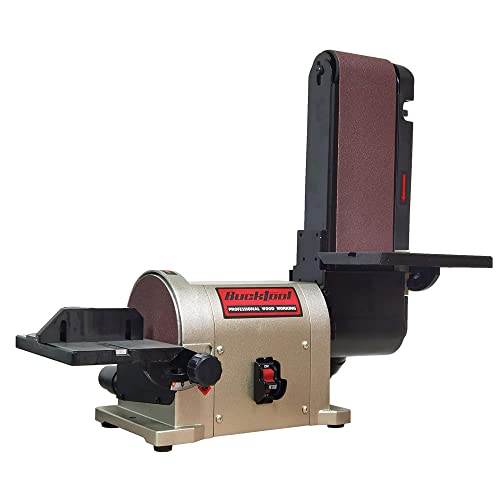
The BD4603 uses a direct-drive motor and a 4×36 belt with an 8-inch disc, designed for efficiency and compact operation. It emphasizes quick belt replacement and a track control function for consistency when changing belts. Best for shops needing direct-drive simplicity and a portable base. Limitations: the motor is tuned for woodworking; metal tasks may require care with material density and heat buildup.
VEVOR 6″ Disc & 4 x 36″ Belt Sander
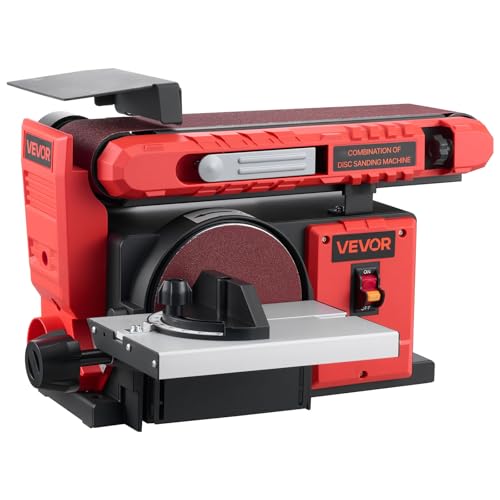
The VEVOR combo features a 400W motor with a 3550 RPM disc and 600 RPM belt. It includes a 0–45° adjustable disc/miter-friendly worktable for precision sanding, plus a dust collection port. Best for hobbyists who value adjustable speed control and a compact design. Limitation: smaller motor capacity may limit heavy stock removal on very tough woods.
Buying Guide: How To Choose Your Belt Disc Sander Combo
- What workpiece size and weight will you most often sand? Larger discs and sturdier bases handle bigger pieces with less vibration.
- How important is speed control? Models with variable belt and disc speeds give you more control for finishes on different woods.
- Do you need tilt flexibility? Be sure the belt and/or disc can tilt from horizontal to vertical and the table offers miter gauge support.
- Is dust control a priority? Dual exhaust ports and efficient dust collection help keep your workspace cleaner and safer.
- What space and portability do you require? Direct-drive designs can be lighter and easier to move, while heavier bases improve stability.
- Which accessories matter? Look for included sandpaper, miter gauges, and easy belt replacement features for faster setup.
Frequently Asked Questions
- What is a belt and disc sander combo best used for? It is ideal for smoothing edges, beveling boards, deburring metals (with appropriate care), and shaping curved surfaces on a range of woodworking projects.
- Should I choose a fixed base or a portable base? A fixed, cast iron or heavy steel base minimizes vibration for better finish; a portable base is useful for a small shop or mobile work.
- How important is tilt range? A belt tilt from 0–90 degrees enables bevel sanding and straightforward contour work, expanding the range of tasks you can perform.
- Is a dual dust port better than a single port? Dual ports improve dust collection efficiency, especially when using both belt and disc simultaneously.
- Do I need a variable-speed model? Variable speed helps adapt to different wood hardness and finish preferences, reducing scorching and chatter on delicate pieces.
- Can these machines handle metal or plastic? These are primarily designed for wood; metal or hard plastics require specialized tooling and caution to prevent damage or safety risks.