
Whether you’re re-sawing planks, making curved cuts, or tackling metal sections, the right band saw blade makes all the difference. This guide highlights five top options that cover wood, plastic, and metal tasks, with clear reasons for who each blade is best for. It’s ideal for hobbyists, DIYers, and small-shop professionals choosing blades for common band saw sizes and task types.
Buyer snapshot: The top picks below are selected to fit popular 14″ and 9″ band saws, with blade lengths and tooth configurations designed for versatility, longevity, and precision. The following quick table helps compare who each blade is best for.
| Product | |
|---|---|
| POWERTEC 93-1/2″ Set (13603) | Versatile woodworking tasks: resawing, ripping, cross-cutting, curves |
| LENOX Tools 44-7/8″ 5-Pack (8010738PW145) | Metal-cutting and general purpose with long life |
| POWERTEC 62″ Set (13601) | Medium-sized band saws, versatile wood cutting |
| AYAO 59-1/2″ Set (3PK) | Affordably covers several common 9″ bandsaw models |
| Bosch BS6412-24M 64-1/2″ | Metal cutting with optimized geometry |
POWERTEC 93-1/2 Inch Bandsaw Blades Assortment

The POWERTEC 93-1/2″ blades provide a three-blade assortment for woodworkers. The set includes one 93-1/2″ x 1/2″ x 6TPI wood blade, one 93-1/2″ x 1/8″ x 14TPI scroll blade, and one 93-1/2″ x 1/4″ x 6TPI wood blade. Best for: re-sawing, rip cuts, cross cuts, and tight curves on hard or soft woods, plastics, and non-ferrous metals. The design emphasizes a precise tooth arrangement for smooth cuts at higher speeds. Caution: use the correct blade width for blade guard clearance and wheel size on your saw.
Who it’s best for: hobby woodworkers needing a affordable, ready-to-use set for common 14″ bandsaw tasks. Why chosen: versatility and included two 6TPI blades cover standard rip and curve work.
LENOX Tools Portable Band Saw Blades, 44-7/8″ x 1/2″ x .020″, 14 TPI, 5-Pack
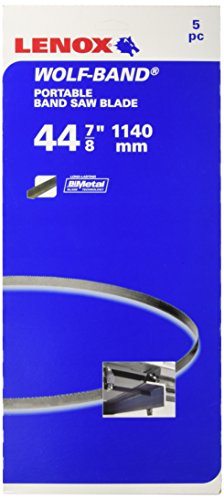
These LENOX blades use high-speed steel teeth to deliver a strong, long-lasting cutting edge. They are shatter resistant and designed as bi-metal blades that bend rather than break, extending blade life. Best for: metal-cutting tasks and mixed-material projects where durability is a priority. Caution: not all 44-7/8″ blades fit every portable band saw—verify compatibility with your model.
Who it’s best for: metalworkers and fabricators seeking reliable life and consistent cuts in aluminum, steel, and other metals. Why chosen: improved durability and resilience for tough cutting jobs.
POWERTEC 62 Inch Bandsaw Blades Assortment (13601)
Included blades are a 62″ wood blade, a 62″ 14TPI scroll blade, and a 62″ 6TPI wood blade. Best for: mid-sized woodworking tasks on POWERTEC-compatible saws, including re-sawing and detailed curve work. Caution: verify wheel size and blade width for your 9″ or larger band saw to ensure proper tension and clearance.
Who it’s best for: woodworkers needing a compact, affordable set for smaller or compact band saws. Why chosen: similar construction to larger POWERTEC sets, with practical sizes for common hobbyist machines.
AYAO 59 1/2 Inch Bandsaw Blades Set

AYAO’s 59 1/2″ blades cover three widths in one set: 1/8″, 1/4″, and 3/8″ wide, all featuring 12TPI, 10TPI, and 6TPI respectively. Best for: Ryobi, Craftsman, Skil, and Wen 9″ bandsaws. These are ground-to-sharp blades designed to stay sharp longer. Caution: blade compatibility depends on your specific model’s wheel size and blade width—verify before purchase.
Who it’s best for: budget-conscious buyers needing a light-to-medium duty assortment for common 9″ and similar machines. Why chosen: multiple widths in one pack improve versatility for diverse tasks.
Bosch BS6412-24M 64-1/2 in. 24 TPI Metal Cutting Blade

Bosch’s BS6412-24M delivers a metal-focused cutting geometry designed to reduce heat buildup and extend blade life. Best for: metal cutting applications in stationary band saws, especially where long, straight cuts are common. Caution: designed for metal work; using it on non-metal materials can reduce efficiency and blade life.
Who it’s best for: metal fabricators and hobbyists who frequently cut aluminum or steel on a stationary band saw. Why chosen: optimized tooth geometry and premium materials for metal cutting tasks.
Buying Guide
Key purchase considerations help ensure you choose the right blade for your saw and tasks:
- Blade length and compatibility: Match blade length to your saw’s wheel size and table space. Common sizes include 62″, 64-1/2″, and 93-1/2″.
- Tooth configuration and pitch: Larger TPI (teeth per inch) blades provide smoother cuts in thin materials and plastics; lower TPI blades remove quicker in wood and thicker stock.
- Blade width: Wider blades straighten better and resist drift in curved cuts; narrow blades excel at tight radius curves but are more prone to guide drift and breakage.
- Material and edge construction: Bi-metal and high-speed steel blades offer different balances of durability and flexibility. Metal-cutting blades require different geometry than woodworking blades.
- Intended material: Confirm if the blade is designed for wood, metal, or mixed materials. Using a blade outside its target material reduces efficiency and blade life.
- Durability and limits: Some blades are designed for heavy-duty work and longer life in tough materials; others prioritize speed for hobby use. Consider your typical workload and maintenance needs.
Frequently Asked Questions
- What blade length should I choose for my 14″ bandsaw?
For most 14″ bandsaws, 93-1/2″ and 62″ blades are common options. Check your machine’s manual for the exact length and width requirements.
- How do I decide between 6TPI and 14TPI blades?
6TPI is better for wood and plastic when you need faster material removal and are cutting thicker stock; 14TPI offers smoother cuts on thin stock and curves.
- Can I use metal-cutting blades on wood?
No. Metal-cutting blades are designed with different tooth geometry and materials; using them on wood can lead to poor cuts and blade damage.
- What is the advantage of bi-metal blades?
Bi-metal blades blend toughness and flexibility, reducing breakage and extending blade life in demanding cuts.
- Should I prioritize blade width for curved cuts?
Yes. Narrow blades (1/8″ to 1/4″) are better for tight radii; wider blades (1/2″ to 3/4″) provide straighter cuts and stability for wider curves.
- Are replacement blades universal for portable band saws?
Compatibility varies by model. Always verify length, width, and tooth pitch against your saw’s specifications before purchasing.