
Choosing the right air compressor for an impact wrench is vital for achieving optimal power and efficiency in automotive and industrial tasks. The air compressor must deliver adequate airflow and pressure to support the impact wrench’s torque requirements. Below is a summary table featuring selected air impact wrenches to help guide your compressor compatibility and tool selection.
| Product | Brand | Max Torque (ft-lbs) | Key Feature |
|---|---|---|---|
| Ingersoll Rand 2235QTiMAX | Ingersoll Rand | 1300 | Quiet Technology |
| Ingersoll Rand 2135QXPA | Ingersoll Rand | 1100 | Nut-Busting Torque |
| Beswell 1/2-Inch Air Impact Wrench | BESWELL | 1180 | Includes Impact Sockets Set |
| AEROPRO TOOLS 1/2-Inch Aluminum Air Impact Wrench | AEROPRO | 1000 (breakaway torque) | 3 Speed Adjustments |
| Ingersoll Rand 231C | Ingersoll Rand | 600 | Adjustable Power Regulator |
Ingersoll Rand 2235QTiMAX 1/2-Inch Air Impact Wrench

The Ingersoll Rand 2235QTiMAX delivers up to 1,300 ft-lbs of torque, making it an ideal choice for heavy-duty suspension work and industrial equipment repair. This model incorporates Quiet Tool technology, significantly reducing operational noise while maintaining excellent power output.
Weighing 4.6 lbs with a compact design, it minimizes hand fatigue during extended use. Constructed with a titanium hammer case and steel wear plate, it offers resilience against harsh environments, ensuring longevity. The impact wrench’s performance is reliable for pro-level tasks, making it a strong match for a compressor capable of providing consistent 90 PSI with sufficient CFM.
Ingersoll Rand 2135QXPA 1/2″ Air Impact Wrench

The Ingersoll Rand 2135QXPA produces an impressive 1,100 ft-lbs of nut-busting torque thanks to its finely tuned motor and twin-hammer impact mechanism. Its user-friendly one-handed forward/reverse control allows for fast direction changes, enhancing efficiency on the job.
This model’s ergonomic design aids comfort for prolonged use, and its rugged build withstands demanding work environments. For optimal output, a compressor that supplies consistent 90 PSI pressure and at least 5-6 SCFM airflow is necessary to match this wrench’s power demands.
Beswell 1/2-Inch Air Impact Wrench with Socket Set

Beswell’s 1/2-Inch Air Impact Wrench boasts a maximum loosen torque of 1,180 ft-lbs, efficiently handling vehicle repair and heavy-duty maintenance tasks. Its twin hammer mechanism and die-cast aluminum end plates enhance durability and impact reliability.
This set comes with a 5-piece CR-V steel impact socket assortment, a quick connector, an L-type wrench, and oil bottle, providing added value and convenience. The tool’s balanced lightweight design (approximately 4.6 lbs) helps reduce operator strain during use. Matching this wrench requires an air compressor capable of steady 90 PSI and around 5 SCFM.
AEROPRO TOOLS 1/2-Inch Aluminum Air Impact Wrench (A398)
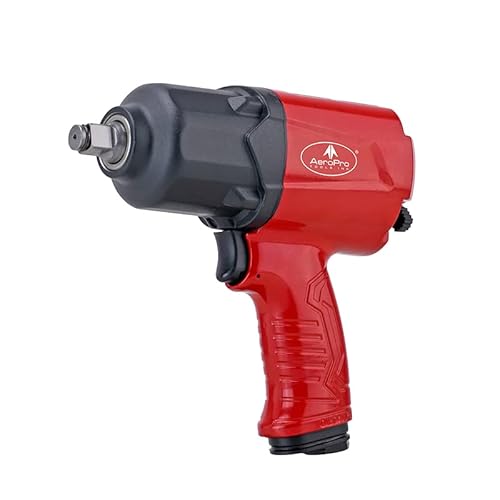
The AEROPRO TOOLS A398 model features a strong twin hammer impact mechanism combined with a 45mm cylinder, delivering a maximum working torque of 850 ft-lbs and breakaway torque reaching 1000 ft-lbs. It offers three speed settings to fine-tune torque output depending on the application.
This wrench’s military-grade Baosteel materials and an anti-aging valve enhance lifespan and sealing integrity. To operate at full capacity, an air compressor with stable 90 PSI and sufficient airflow around 5 SCFM is recommended.
Ingersoll Rand 231C 1/2-Inch-Drive Air Impact Wrench

The Ingersoll Rand 231C delivers a balanced performance with a maximum torque of 600 ft-lbs, coupled with an adjustable power regulator for precise control. It features a twin hammer mechanism ensuring efficient, high-speed impact delivery up to 8,000 RPM.
Designed with a lightweight, ergonomic contoured handle, this impact wrench minimizes user fatigue. Its pressure-feed lubrication and two-piece construction facilitate easier maintenance. This tool is well-suited for medium-duty applications and pairs well with air compressors providing approximately 4-5 SCFM at 90 PSI.
Buying Guide: Key Considerations for Selecting an Air Compressor for Impact Wrenches
1. Air Pressure (PSI) Requirements
Impact wrenches generally operate efficiently at 90 PSI. Your air compressor must consistently provide this pressure level under load to ensure the wrench delivers its rated torque without air pressure drops.
2. Airflow Capacity (CFM)
The most critical factor is the volume of air the compressor can supply, measured in cubic feet per minute (CFM). Larger impact wrenches with high torque—above 1,000 ft-lbs—require compressor output of at least 5 to 7 CFM at 90 PSI. Medium-duty models may function acceptably on 4-5 CFM.
3. Tank Size and Duty Cycle
A larger tank (>20 gallons) allows the compressor to store more air, reducing motor cycling frequency and providing smoother airflow. Consider compressors with high duty cycles for extended periods of continuous wrench use in professional settings.
4. Compressor Type: Oil-Lubricated vs. Oil-Free
- Oil-Lubricated Compressors generally offer better cooling, quieter operation, and increased longevity—ideal for heavy, frequent duty.
- Oil-Free Compressors are lighter and require less maintenance but typically have shorter lifespans and more noise.
5. Portability vs. Fixed Installation
For garage or mobile mechanic environments, portable air compressors with wheels and manageable weight are preferable. For industrial or fixed applications, larger stationary compressors can sustain higher airflow and pressure.
6. Noise Levels
Some compressors offer noise-reduction features. If you pair with a quiet impact wrench like the 2235QTiMAX, consider a compressor designed to operate quietly to reduce overall workspace noise.
7. Hose and Accessory Compatibility
Ensure the compressor has suitable fittings and capacity to connect your impact wrench and other pneumatic tools. Appropriate hose diameter and length help maintain air pressure and reduce restrictions.
8. Power Source
Electric compressors (120V or 240V) are most common for shop use, while gas-powered compressors are suitable for outdoor job sites lacking electrical access.