
Find the right stud finder without breaking the bank. This guide highlights five affordable options that balance accuracy, ease of use, and durability for typical home projects. Ideal buyers include new homeowners hanging pictures, DIY enthusiasts installing shelves, and renters who need reliable wall mapping without professional tools. Below is a quick summary and comparison to help you choose quickly.
| Product | Best For | Key Benefit |
|---|---|---|
| CRAFTSMAN Stud Finder (CMHT77633) | General drywall projects | Edge detection; works on wallpaper/fabric |
| JAXWQ 5-in-1 Stud Finder | Precision scanning & live wires | HD LCD, center/edge detection |
| The Original StudBuddy | Simple magnetic use | No batteries; quick reference for drywalls |
| DEWALT DW0100 | Wood and metal framing | Center-find with LED guidance |
| Franklin Sensors ProSensor M210 | Highest accuracy | 13 sensors; full stud width display |
CRAFTSMAN Stud Finder, 3/4-Inch Depth

The Craftsman CMHT77633 offers a practical depth range of ¾ inch and edge-detection to locate stud edges in wood or metal. It also claims durability with a shock-resistant and water-resistant body, making it suitable for regular garage or workshop use. Best for homeowners and renters who need a reliable tool for standard wall setups without complicated modes. A potential limitation is surface sensitivity; on very dense or multi-layer surfaces, you may need a precise slow pass to confirm edges.
Stud Finder Wall Scanner – 5 in 1

This 5-in-1 tool from JAXWQ emphasizes accuracy and speed, using a smart micro-sensor to detect edges and centers of wood, metal studs, joists, pipes, and live AC wires. It features a bright backlit LCD, audible alerts, and clear location indicators. Best for DIYers who frequently mount heavy shelves or TVs and want live wire detection. A limitation is that it may require steady calibration and careful handling to avoid misreads on dense surfaces.
The Original StudBuddy Magnetic Stud Finder

The StudBuddy uses strong magnets to find screws in studs, offering a simple, battery-free approach. It is made in the USA and is best for drywall and wood surfaces where quick placement is needed and you want to avoid electronics. Not ideal for plaster walls with irregular screw patterns or very thick lath layers, where a magnetic tool may miss edges.
eOUTIL Stud Finder Wall Scanner

The eOUTIL ST100B claims 3/4 inch depth detection for wood and metal with sound and visual indicators. It emphasizes compatibility with varied wall surfaces, including wallpaper and painted walls, making it versatile for apartments or homes with textured walls. One caution is that interface design can be less intuitive for first-time users; practice on a known surface before serious mounting work.
DEWALT Stud Finder, 3/4”

DEWALT’s DW0100 centers on finding the stud center with a clear ¾-inch detection depth for wood and metal and includes AC and live-wire detection for added safety. This model is well-suited for wood framing projects or metal studs common in garages and basements. A potential drawback is that it may be less feature-rich than multi-sensor scanners, but its reliability is a strong suit for straightforward tasks.
Franklin Sensors ProSensor M210
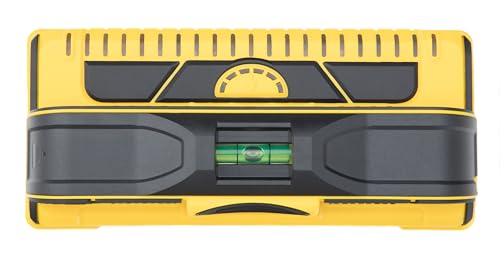
The ProSensor M210 provides high accuracy with 13 sensors and a wide LED display showing the stud center and edges. It includes live-wire detection, supporting safer drilling. Best for users needing precise width mapping of studs and confident center detection. It’s more complex than simple single-sensor models, so beginners may need a short acclimation period to interpret the LED indicators effectively. It is particularly suited to professional-level home projects where accuracy matters most.
Buying Guide: Key Purchase Considerations
- Detection depth and surface compatibility: Choose 3/4 inch depth for typical walls. If you have thick drywall or composite surfaces, consider a model with stronger sensors.
- Multiple detection targets: If you often hang heavy items or work near wiring, a scanner that detects live wires and pipes is advantageous.
- Display and alerts: Backlit LCDs and audible alerts help in low-light environments or busy rooms. Clear edge and center indicators reduce guesswork.
- Durability and ease of use: Ergonomic designs and durable builds prevent wear in workshops. Magnetic or simple button controls suit quick tasks.
- Americans-made considerations: Some buyers prefer US-made tools for perceived quality and local support, as seen in StudBuddy and certain Franklin Sensors models.
- Budget vs. accuracy balance: 5-in-1 scanners offer more features but can be pricier than single-sensor options; pick based on project needs and comfort with electronics.
Frequently Asked Questions
- What is the typical depth I need for most walls? Typically 3/4 inch is sufficient for standard drywall and common studs.
- Do I need a live-wire detector? Yes, if you plan to install near outlets, switches, or electrical wiring to reduce the risk of shocks.
- Are magnetic stud finders reliable? Magnetic finders work well on drywalls with standard screw spacing but may miss studs behind plaster or irregular walls.
- Which type is easiest for beginners? Magnetic StudBuddy offers a straightforward, no-battery option, while 5-in-1 scanners are good for those who want more data in one tool.
- Can I use a stud finder on wallpapered walls? Some models advertise compatibility with wallpaper or textured finishes, but results can vary; ensure the surface isn’t too thick for edge detection.
- Is accuracy more important than features? For mounting heavy objects, higher accuracy and full-stud width display (as in ProSensor models) usually matter more than extra features.