
Turning your RV into a reliable off-grid setup is easier with a quality solar panel kit. The top kits below are well-suited for campsites, full-timers, and weekend travelers who want steady power for lights, electronics, and small appliances. Each option includes a durable panel, a charge controller, and mounting hardware designed for RV use, with varying wattage to fit different space and power needs.
| Product | Brand | Approx. Wattage | Notes |
|---|---|---|---|
| ECO-WORTHY 200W Solar Panel Kit | ECO-WORTHY | 200W | Monocrystalline cells, 30A PWM controller, robust build |
| Renogy Adventurer 200W Kit | Renogy | 200W | LCD PWM controller, mounting brackets included |
| Renogy 200W Portable Foldable 200W Kit | Renogy | 200W | Foldable, lightweight, MC4 output, portable for tight spaces |
| TWELSEAVAN 200W Portable Solar Panel Kit | TWELSEAVAN | 200W | 8-in-1 MC4 connectors, Type-C and USB ports, durable ETFE |
| ZOUPW 100W Portable Solar Panel Kit | ZOUPW | 100W | Foldable, IP68 rating, included PWM controller and accessories |
ECO-WORTHY 200 Watts Kit for RVs

The ECO-WORTHY kit combines a high-efficiency monocrystalline panel with a 30A PWM charge controller, designed for RVs and off-grid use. It offers a daily output potential of about 800Wh under strong sun, suitable for lighting, small appliances, and essential electronics. The panel uses a corrosion-resistant aluminum frame and is rated for wind and snow loads, delivering long-term durability for mobile lifestyles. The IP65 junction box provides weather protection, while the 35.2 x 23.1 x 37 inch footprint fits many RV roof spaces. This kit is a strong all-in-one solution for campers seeking reliable daytime charging with straightforward setup.
Renogy Adventurer 200W Kit
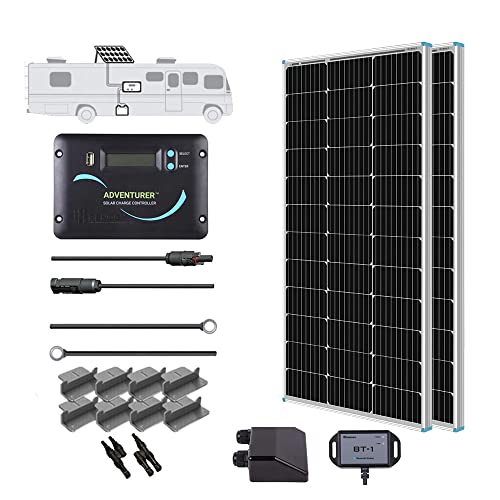
The Renogy Adventurer 200W Kit is tailored for RVs and small boats with a compact footprint and a 30A PWM controller. The 22% efficiency monocrystalline cells and a corrosion-resistant aluminum frame provide dependable outdoor performance. Suitable for extended trips or weekend getaways, this kit focuses on reliable power delivery while maintaining a neat installation on camper walls. Its controller offers over-charge, over-voltage, and short-circuit protection to help protect batteries in off-grid settings.
Renogy 200W Portable Foldable Kit

This Renogy foldable kit is designed for RV travelers who need portability without compromising power. The 200W foldable panel features a lightweight design and MC4 output, enabling easy charging of portable power stations or direct 12V battery systems. It’s ideal for RVing where space is premium, and setup should be quick. The included hardware supports mounting on RV awnings or storage bays, with weather-resistant construction to endure travel conditions.
TWELSEAVAN 200W Portable Solar Panel Kit

The TWELSEAVAN 200W kit emphasizes fast charging and broad compatibility. Its high-efficiency monocrystalline cells achieve up to 24% conversion, with ETFE lamination for durability and light transmission. The 9.8-foot MC4 cable and 5-in-1 connector help connect to most portable power stations, making it a flexible option for RVs, vans, or boats. It also includes multiple USB charging ports (QC3.0, Type-C PD) for charging devices directly from the panel, adding convenience on the road.
ZOUPW 100W Portable Solar Panel Kit

The ZOUPW kit provides a compact 100W option with IP68 waterproofing for off-road and RV use. It includes a 20A PWM controller and a foldable design that fits easily in smaller storage areas. With wide compatibility and a robust build, this kit suits RVers who need dependable daytime charging without a large roof footprint. The included accessories help streamline installation and connection to 12V systems or power stations.
Buying Guide: Key Considerations For RV Solar Panel Upgrades
- Power needs and space: Assess daily energy usage (lights, fridge, chargers) and roof area. Larger rigs benefit from 200W or more, while smaller setups can start with 100W to 150W kits.
- Panel and controller type: Monocrystalline panels offer high efficiency and better performance in partial sun. PWM controllers suit simple setups; MPPT controllers extract more power in variable conditions but cost more.
- Portability vs. permanence: Roof-mounted kits save interior space but require some installation work. Foldable/portable kits are ideal for limited roof space or rental RVs, with quick setup and breakdown.
- Durability and weather resistance: Look for corrosion-resistant frames, IP ratings, and robust laminates (ETFE or tempered glass) to withstand wind, rain, and road vibrations.
- Installation flexibility: Check mounting hardware compatibility with your RV’s roof structure and whether additional brackets or sealants are needed for a watertight fit.
- System integration: Confirm compatibility with your existing battery bank (12V systems), inverter, and any pre-wired RV solar ports. Consider future expansion with additional panels or advanced MPPT controllers.
- Portability of power: If you rely on portable power stations, choose kits with MC4 outputs and appropriate adapters to connect to those stations.
- Warranty and support: Review manufacturer warranties, customer support, and availability of replacement parts for longer-term reliability on extended trips.
- Budget vs. value: A higher wattage kit increases upfront cost but reduces the need for frequent recharges, especially in off-grid locations with variable sun exposure.
Selecting the right RV solar kit involves balancing power needs, roof space, and budget. The options above cover roof-mounted and portable configurations with reliable controllers and durable construction. For most RVers, a 200W kit paired with a capable battery system offers a practical blend of performance and expandability, while smaller or portable setups provide flexibility for weekend travelers or vehicles with limited roof area.