
Explore top 800-watt solar panel kits and modules designed for off-grid setups, RVs, cabins, and boats. This guide summarizes high-efficiency options from trusted brands, highlighting technology, compatibility, and installation considerations to help you choose the right 800W solution for steady, reliable power.
Summary of Selected Products:
| Product | Brand | Key Benefit | Type |
|---|---|---|---|
| Rvpozwer 18BB 800W Panel Kit | Rvpozwer | 25% efficiency, N-Type cells | 4×200W Panels |
| DOKIO 800W (2×400W) Panels | DOKIO | 3 m leads per panel, 12/24V compatibility | Two 400W Panels |
| Renogy ShadowFlux 800W Kit | Renogy | Anti-shading tech, durable N-Type 16BB | 4×200W Panels |
| Greenmagic 800W Portable Kit | Greenmagic | 23% efficiency, foldable, IP67 | 2×400W Portable Panels |
| GCUSSZ 800W Flexible Kit | GCUSSZ | Flexible mounting, curved surfaces | 2×400W+ 40A Controller Kit |
Rvpozwer 800W Solar Panel Kit
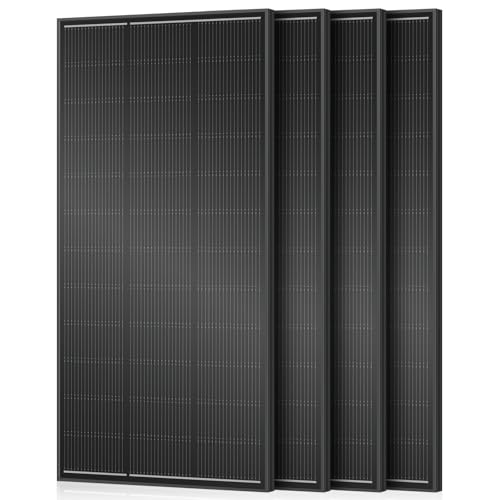
The RVPOZWER 18BB 800W set combines four 200W panels using advanced 18BB technology and N-Type cells. The 25% conversion efficiency supports higher energy production in limited space, making it suitable for RVs, boats, and off-grid homes. Pre-drilled holes on the back enable quick mounting and flexible angle adjustments to fit various setups.
Key features include: 18BB technology for improved longevity, N-Type cells with 25% efficiency, and easy installation with compatible brackets. In practice, the system can generate roughly 1,000 watt-hours per day under moderate sun. The compact, modular design supports parallel or series wiring based on your inverter/controller capacity. This kit is well-suited for users prioritizing efficiency and straightforward installation in mobile or fixed off-grid environments.
DOKIO 800W (2×400W) Mono Panels

This DOKIO configuration provides two 400W monocrystalline panels that are compatible with 12/24V battery systems. Each panel includes a 3 m MC4 lead, facilitating longer runs to a charge controller or a combiner, which reduces the number of connections required and simplifies setup. The kit is ideal for garden sheds, cabins, boats, or RVs where space is a premium and a robust, modular solar array is desired.
Features emphasize outdoor readiness with a tempered glass and aluminum frame, sealed junction boxes, and compatibility with various battery chemistries (AGM, Gel, LiFePO4 via PWM/MPPT). For larger off-grid projects, this setup scales well by adding more panels in parallel to keep voltage steady while increasing current.
Renogy ShadowFlux 800W Kit

Renogy’s ShadowFlux 800W kit uses 16BB N-Type cells, delivering up to 25% efficiency with reduced hot spots and micro-cracks. The anti-shading technology helps maintain power output when panels are partially shaded by trees, buildings, or equipment. The panels are described as compact and lightweight relative to other 200W modules, easing installation on smaller RV roofs or cabin rooftops.
In practice, the ShadowFlux design offers robust performance in challenging climates, with improved reliability during partial shading. Its durability and efficiency make it a strong option for users seeking high energy density in a limited mounting area, particularly in rooftop installations on vehicles and small off-grid structures.
Greenmagic 800W Portable Solar Kit
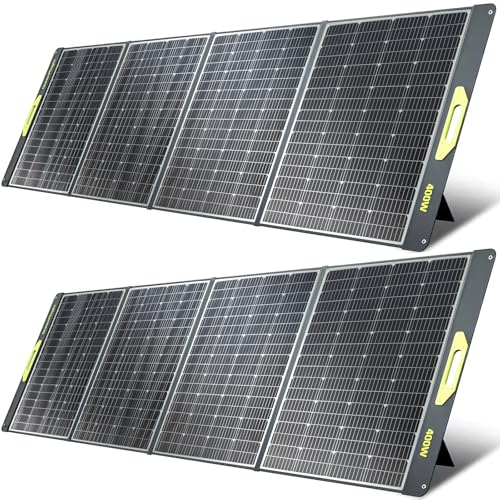
This 800W portable kit consists of two 400W panels designed for mobility and rapid deployment. It emphasizes high efficiency with Sunpower cells, offering up to 23% conversion in bright sun. The foldable, lightweight design (roughly 20 pounds for the pair) makes it suitable for campers, RV travelers, and emergency power kits. ETFE coating enhances durability while maintaining flexibility for different mounting angles. IP67 waterproofing adds weather resistance for outdoor use.
This kit is particularly appealing for users who prioritize portability without sacrificing power yield. Its foldable form factor, alongside solid weather protection, makes it a practical option for temporary setups or transportation-heavy lifestyles where space and weight matter.
GCUSSZ 800W Flexible Panel Kit

GCUSSZ offers a flexible 800W kit designed for curved surfaces on RVs, boats, or irregular roofs. It emphasizes practical power in challenging locations, with monocrystalline cells and a light, adaptable frame. The included 40A charge controller supports 12–24V battery charging, enabling compatibility with a wide range of battery chemistries. The flexible design allows mounting on trailers or cabins where rigid panels would not fit well.
Consider this option when your installation surface is curved or non-traditional. While flexibility can ease mounting, verify your controller and wiring strategy to ensure safe and efficient operation across your system voltage and load demands.
Buying Guide — Key Purchase Considerations
- System voltage and controller compatibility: Many 800W kits are meant for 12/24V systems. Check MPPT compatibility and ensure the charge controller can handle the total current from all panels in your chosen configuration (parallel vs. series).
- Cell technology and efficiency: N-Type cells (18BB/16BB) typically offer higher efficiency and better performance in shaded or low-light conditions than older 5BB or 9BB designs. Higher efficiency translates to more usable power from limited roof space.
- Durability and weather resistance: Look for tempered glass, aluminum frames, ETFE coatings, and IP ratings. Off-grid and mobile use benefits from robust construction to withstand wind, snow, and moisture.
- Mounting and installation: Pre-drilled holes, included brackets, and modular panel configurations simplify installation on RVs, boats, or cabins. For curved surfaces, consider flexible panels with adhesive or clamp mounting options.
- Portability vs. fixed installation: Portable kits offer quick deployment and storage during travel, while fixed roof panels provide continuous power with permanent mounting. Your choice should reflect travel frequency, space, and convenience needs.
- Maintenance and warranty: Verify product warranties and the availability of replacement parts or flex cables (MC4 leads). Durable coatings and sealed junction boxes reduce maintenance requirements in harsh environments.
- System integration: Plan for wiring runs, distance to the charge controller, and potential need for multiple strings. Longer MC4 leads reduce extensions but ensure voltage and current stay within safe levels for your equipment.
- Budget vs. performance: Higher-efficiency panels generally cost more but may deliver more usable power per square foot. Consider your space constraints, daily energy needs, and charging goals when evaluating value.
When selecting an 800W solar setup, align your choice with your typical sun exposure, roof or mounting area, and energy targets. Panel efficiency, shading tolerance, and mounting flexibility collectively determine how much usable energy you’ll harvest each day in real-world conditions.