
If you need reliable 4000-watt power with minimal noise, a quiet inverter model can keep conversations peaceful, protect sensitive electronics, and extend run times during camping trips or home backup. The following selections emphasize low noise, efficiency, and practical features like RV compatibility, fuel options, and parallel capability. This guide compares popular options so you can choose a generator that fits your setting without sacrificing performance.
| Product | Approx Noise | Run Time (Gas) | Fuel Type |
|---|---|---|---|
| Champion Power Equipment 4000-Watt RV Ready Portable Inverter Generator | 64 dBA at 23 feet | Up to 10 hours | Gasoline |
| Aceup Energy 4000 Watt Inverter Generator | Quiet operation (inverter design) | Up to 5 hours at half-load | Gasoline |
| Pulsar PGD40ISCO Ultra Light Quiet 4000W | 59 dB typical | About 4 hours at half load | Gasoline |
| Westinghouse 4000 Peak Watt Dual Fuel | Sophisticated quiet operation (inverter based) | Not specified (gas/propane modes) | Gasoline/Propane |
| Pulsar GD400BN Dual Fuel 4000W | Ultra-quiet design (dual fuel) | Up to 4.5 hours at half load | Gas/Propane |
Champion Power Equipment 4000-Watt Inverter with Quiet Technology

Designed for portability and quiet operation, this model weighs less than 49 pounds, making it one of the lighter 4000-watt inverters. It delivers 4000 starting watts and 3000 running watts with up to 10 hours of runtime. A CO Shield carbon monoxide auto shutoff system adds a safety layer for enclosed spaces, and the optional parallel kit lets you link another 4000-watt Champion inverter for increased power. Noise remains around 64 dBA at 23 feet, suitable for camping, tailgating, or essential home use.
Aceup Energy 4000 Watt Inverter Generator
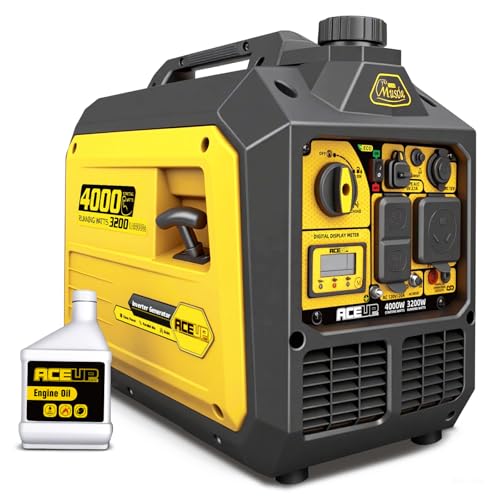
Powered by a 149cc engine, this inverter generator provides 4000 peak watts and 3200 rated watts with a recoil start. It runs up to about 5 hours at half-load on a 1.32-gallon tank. The intelligent gauge tracks voltage, runtime, gasoline level, hertz, and power output, helping monitor efficiency. Features include a low-oil indicator and an economic mode for fuel savings. Standard outlets include 120V AC, an RV receptacle, and a 12V DC car charger. It is parallel-ready, enabling doubled output with a separate kit.
Pulsar PGD40ISCO Ultra Light Quiet 4000W

This Pulsar model delivers 4,000 peak watts and 3,200 running watts with a compact, lightweight profile. Its 1-gallon fuel tank yields roughly 4 hours of operation at half load, and its design emphasizes quiet operation. Ideal for portable use in camping setups or as a backup for essential electronics, the unit emphasizes efficiency and portability alongside reliable power output.
Champion Power Equipment 4000-Watt Dual Fuel RV Ready

This dual-fuel Champion model runs on gasoline or propane, with CO Shield carbon monoxide auto shutoff for safety. It provides 4000 starting watts and 3000 running watts when using gasoline, offering up to 10 hours of runtime. In propane mode, it produces 2700 running watts with up to 25 hours of runtime. The unit remains quiet for its class and supports a parallel kit option to increase power when needed, making it versatile for RVing or home backup.
Westinghouse 4000 Peak Watt Dual Fuel Portable Inverter

Westinghouse offers 4000 peak watts and 3300 rated watts with a sub-3% total harmonic distortion. The unit runs on gasoline or propane and includes a remote start with a key fob, along with both electric and recoil starts. It features multiple outlets (household, RV, and USB), LED data display for fuel, power, runtime, voltage, and hours, and a CO sensor with shutoff. It’s designed for travel trailers, home use, and portable power needs while maintaining a compact silhouette and easy maneuverability.
Pulsar GD400BN 4000W Dual Fuel & Parallel

The Pulsar GD400BN provides 4000 peak watts and 3200 running watts on gasoline, with 3600 peak and 2800 running watts on propane. It offers continuous operation up to 4.5 hours at half load with a 1.1-gallon fuel tank. The generator is designed for RV-ready and backup use, with dual-fuel flexibility and a compact, portable form that supports easy transport and setup during outdoor activities or emergencies.
Buying Guide
- Noise level: If quiet operation is a priority, look for models advertising dBA at a distance (e.g., 59–64 dBA at 23 feet). Inverter designs typically reduce engine noise and provide cleaner power.
- Power output and surge: Ensure the starting watts meet your essential devices and consider running watts for everyday needs. If you anticipate heavy loads, consider models with parallel capability to double capacity.
- Fuel options: Dual-fuel generators offer flexibility during fuel shortages or propane availability. Gasoline generally provides longer raw runtime per tank, while propane can be cleaner and easier to store.
- Run time and tank size: Compare run times at half-load to estimate endurance for camping or outages. Larger tanks extend runtime but may add weight and size.
- Safety and electronics protection: Features like CO shutoff (CO Shield) protect against hazardous buildup, especially in enclosed spaces. Inverters deliver clean power suitable for sensitive electronics.
- Portability and features: Weight, handle design, wheel kits, and remote or electric start improve usability. Outlets (110V, RV 30A, USB) determine compatibility with devices and trailers.
- Fuel efficiency and maintenance: Look for fuel gauges, economical mode settings, and low-oil indicators to manage maintenance and fuel usage efficiently.
- Parallel capability: If you anticipate higher power needs, ensure the model supports parallel connections with compatible units and kits sold separately.
- Compliance and emissions: If you’re in areas with strict CARB or EPA requirements, verify that the model is compliant for your region.