
Choosing a reliable 3000-watt gas generator involves balancing portability, fuel flexibility, and runtime. This guide reviews five top options suitable for campers, RVs, and home backup. Each model offers solid starts, quiet operation, and practical features like CO detection or electric start. Read through the options, compare their fuel versatility and outputs, and explore practical buying considerations to pick the best fit for your needs.
| Product | Brand | Fuel Type | Approximate Power (W) |
|---|---|---|---|
| DK 3000W Dual Fuel Inverter Generator | DD DINKING | Gas / LPG | 3000 Starting / 2500 Running (Gas); 2800 Peak / 2300 Running (LPG) |
| Generac GP3300i Portable Inverter Generator | Generac | Gas | 3300 Starting / 3000 Running |
| GENMAX GM3300i Portable Generator | GENMAX | Gas | 3300 Starting / 3000 Running |
| CRAFTSMAN C0010030 3,000-Watt Generator | CRAFTSMAN | Gas | 3000 Starting / running watts around 2700-3000 depending on load |
| DuroMax XP13000HX 13,000-Watt Dual Fuel | DuroMax | Gas / Propane | 13,000 Peak; dual fuel (not 3000W but listed for comparison) |
Below are detailed implications for each model, followed by a practical buying guide focused on fuel options, noise, runtime, and safety features.
DK 3000W Dual Fuel Inverter Generator

The DK3000iD is highlighted as one of the smallest and lightest dual-fuel inverter generators in the 2000-3000W range. At 18.9″ x 11.4″ x 17.3″ and 45.2 lbs, it is designed for portable outdoor power needs. In gas mode, it offers 3000W starting and 2500W running, with a built-in 1.0-gallon tank for about five hours at half-load. LPG mode increases peak to 2800W and running to 2300W, extending runtime. The 145cc engine is noted for higher displacement relative to peers, contributing to durability under sustained load.
Key considerations include dual-fuel flexibility for varied fuel availability, compact form factor for RVs and tailgating, and a focus on professional-grade endurance. Potential trade-offs involve run time under high loads versus larger, heavier outputs from bigger models.
Generac GP3300i Portable Inverter Generator

Generac’s GP3300i inverter generator is designed for quiet, stable power—suitable for sensitive electronics and recreational use. It emphasizes TruePower technology for high-quality, clean power, reducing the risk of harming devices. PowerRush technology claims more than 50% extra starting capacity, making it capable of handling tools, appliances, and motor-driven equipment with confidence. This model is a practical choice for campers and home backup, offering reliable performance without excessive noise.
Important factors include its balance of portability and power, inverter-based efficiency, and the benefit of clean output for electronics. Users should consider runtime under half-load and startup requirements for heavy devices to ensure it meets their needs in outdoor or backup scenarios.
GENMAX GM3300i Portable Generator
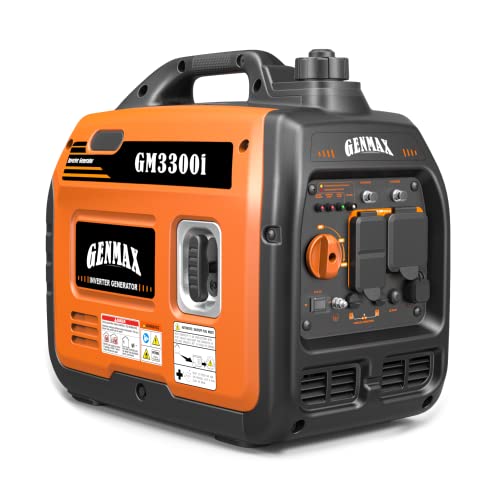
The GENMAX GM3300i provides a compact 3300 starting watts with 3000 running watts, coupled with inverter technology for stable power suitable for sensitive electronics. Its ultralight design—around 47 pounds—facilitates transport and storage, and the unit’s enclosed housing aims to reduce noise. The Eco Mode feature contributes to fuel efficiency, aligning performance with quiet operation for camping and RV use.
Considerations for this model include its portability, noise profile, and fuel economy. For users needing to power laptops, phones, and small appliances on the go, the GM3300i offers a favorable blend of light weight and stable output. A potential limitation may be the total runtime at higher loads, which warrants planning around fuel capacity.
CRAFTSMAN C0010030 3,000-Watt Generator

Craftsman’s 3,000-watt portable generator emphasizes mobility with a built-in handle for easy transport. It aims to deliver steady power for sensitive electronics, supported by advanced technology to ensure safe power delivery. The Start/Stop/Choke dial simplifies operation for quick use in outdoor settings. This model is positioned for general outdoor activity power needs, including camping and tailgating, with CARB/CARB-compliant status in the product line.
Buying considerations include ease of starting, physical footprint, and compatibility with household outlets or extension setups. While it provides reliable peak power for devices, users should assess fuel consumption at typical loads and plan for periodic maintenance to maintain performance.
DuroMax XP13000HX 13,000-Watt Dual Fuel

The XP13000HX is a large, heavy-duty option with 13,000 watts, designed for whole-home power when needed. It supports dual fuel—gasoline and propane—enhancing fuel availability and flexibility. A CO Alert system provides added safety against fumes during operation. Its robust 500cc OHV engine and copper windings emphasize durability and long-term performance for serious backup power or jobsite use. This model serves as a benchmark for high-output needs rather than a compact portable solution.
Key considerations include fuel versatility, safety sensors, and overall fuel economy in relation to output. For users prioritizing high power for critical loads, this model offers substantial headroom, though it is heavier and louder than smaller units and may require more storage space and ongoing maintenance.
Buying Guide: Key Purchase Considerations For 3000 Watt Gas Generators
- Fuel flexibility: Dual-fuel units provide options with gasoline and LPG or propane. Assess fuel availability and storage capacity to maximize runtime between fills.
- Output stability: Inverter-based generators deliver cleaner power suitable for electronics. Look for TruePower or similar specs for sensitive devices.
- Portability vs. power: Smaller units (around 40-50 lbs) offer easier transport but may have shorter runtimes at peak loads. Larger models deliver more power but require more space and handling.
- Run time and fuel tank size: Consider the tank capacity and efficiency at half-load to estimate how long you can operate without refueling, especially for camping or backup scenarios.
- Noise levels: Quieter operation improves usability in campsites, RV parks, and urban backyards. Enclosed housings and inverter technology contribute to lower noise.
- Safety features: CO sensors or CO shutdown, automatic low-oil shutdown, and robust grounding are important for safe operation in enclosed spaces or near living areas.
- Electric start vs manual: Electric start adds convenience, especially after storage periods, but may require a battery and occasional maintenance.
- Certification and compliance: Look for EPA, CARB, and 50-state compliance to ensure legal operation in your region and safe emissions.
- Warranty and support: A robust warranty can offset maintenance concerns, particularly for heavy-use or outdoor-based power backups.
Using these considerations helps tailor the selection to your primary use—camping, tailgating, RV trips, or home backup—while balancing budget, weight, and fuel availability.