
Finding reliable pure sine wave inverters around the 2000-watt range helps power sensitive electronics, appliances, and off-grid systems without the grid. The following selections are 2kW-class models offering high efficiency, safety protections, and convenient monitoring features. This guide highlights top models from reputable brands to help you compare performance, safety, and usability in real-world setups.
| Product | Brand | Power |
|---|---|---|
| Renogy Inverter P2 2000W Pure Sine Wave | Renogy | 2000W continuous |
| Renogy Inverter PUH, 2000W Pure Sine Wave with UPS Transfer | Renogy | 2000W continuous |
| BELTTT 2000W Pure Sine Wave Inverter | BELTTT | 2000W continuous |
| LANDERPOW 3000W Pure Sine Wave Inverter | LANDERPOW | 3000W continuous |
| Ampeak 2000W Pure Sine Wave Inverter | Ampeak | 2000W continuous |
Below are five 2kW-class pure sine wave inverters with features like built-in transfer switches, USB charging, remote monitoring, and multiple AC outlets. Each section includes a quick overview, key protections, and practical notes to aid comparison.
Renogy Inverter P2 2000W Pure Sine Wave Inverter

This 2000-watt inverter converts 12V DC to 110V AC with a pure sine wave, delivering up to 4000W peak. It emphasizes high conversion efficiency and uses protection features to guard against under/over voltage, over-temperature, overload, and short circuits. Its design supports long-life operation for electronics such as TVs, laptops, and appliances, with quiet performance on inductive loads.
Renogy Inverter PUH, 2000W Pure Sine Wave with UPS

The PUH model adds an UPS transfer switch for seamless on-grid and off-grid transitions. It includes built-in Bluetooth and a wired remote switch, enabling monitoring via the Renogy App and remote control. Efficiency exceeds 92%, with low power consumption, making it suitable for RVs, trucks, and camping setups where energy reliability matters.
BESTEK 500W Pure Sine Wave Inverter
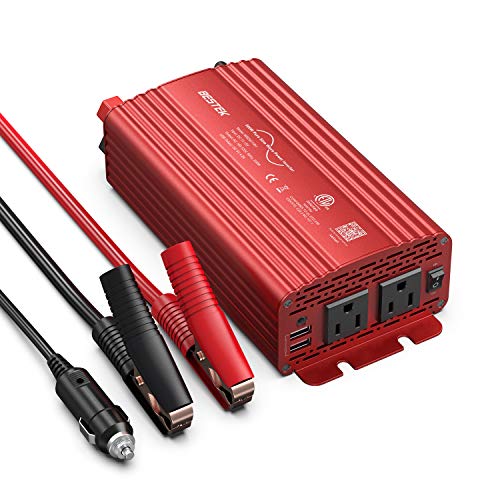
Although rated at 500W, this model is often included in discussions of pure sine wave reliability due to its clean waveform and integrated USB ports. It provides dual AC outlets and two USB charging ports, with thermally protected operation and a compact form factor. It is best suited for smaller off-grid needs or backup power for sensitive electronics, not for heavy inductive loads at scale.
LANDERPOW 3000W Pure Sine Wave Inverter

This model delivers 3000W continuous power with a 6000W surge capacity and over 91% efficiency. It supports three AC outlets and 30W USB-C plus standard USB ports, plus a hardwire terminal. Its positive attributes include strong startup handling for appliances like refrigerators and window ACs, along with a clear LCD-style readout for input/output and status monitoring.
Ampeak 2000W Pure Sine Wave Inverter

The Ampeak inverter provides 2000W continuous power with 2200W peak. It includes two USB ports, three AC outlets, and a cigarette lighter port, along with a 3-foot 4 AWG battery cable. It emphasizes 17 safety protections, an LCD display for status, and a design oriented toward camping, emergency backup, or backcountry power needs.
Buying Guide: Key Considerations for 2kW Pure Sine Wave Inverters
- Power needs and surge capacity: Ensure the continuous rating and surge power meet or exceed your peak startup requirements for devices like refrigerators, tools, or power tools.
- Pure sine wave quality: Look for THD (total harmonic distortion) details and load performance on inductive and capacitive loads to protect sensitive electronics.
- Transfer switch and grid interaction: An onboard UPS transfer switch or external transfer options provide seamless switching between off-grid and on-grid power, reducing downtime.
- Efficiency and cooling: Higher efficiency reduces energy waste; prefer units with effective cooling and protections against overheating during heavy loads.
- Connectivity and monitoring: Bluetooth, App support, LCD displays, and remote switches improve usability and remote management for RVs and remote sites.
- Safety protections: Overload, over-voltage, under-voltage, short-circuit, over-temperature, and ground-fault protection help safeguard both inverter hardware and connected devices.
- Outlets and ports: Check the number and type of outlets, USB ports, and USB-C/PD options to match device charging needs and layouts in your vehicle or site.
- Physical design and installation: Consider mounting options, weight, cable compatibility, and whether a hardwired port is preferred for a clean installation.
- Budget and dealer support: Compare warranties, customer support, and availability of spare fuses or replacement parts when planning long-term use.