
Choosing the right 12V DC motor for a DIY generator or wind turbine project can be challenging with so many options. This guide highlights five reliable motors that cover a range of speeds, torque, and mounting styles. Each pick is suitable for hands-on experiments, educational projects, and small-scale generators. The products shown come from reputable brands and feature clear specifications to help you compare performance and compatibility for your setup.
Summary of chosen products
| Product | Brand | Voltage | Approx. Speed | Key Use | Link |
|---|---|---|---|---|---|
| EUDAX Mini Generator Motors | EUDAX | 3V / 4.5V / 12V | 1500–6500 RPM | DIY toys, wind turbine, science kits | Amazon |
| High Torque DC Motor 12V/24V (XD-3420) | XD-3420 | 12V / 24V | 3500 / 7000 RPM | Generators, small machinery | Amazon |
| 12V 30W Permanent Magnet DC Motor (Together-life) | Together-life | 12V | 3000 RPM | DIY generator, control projects | Amazon |
| Coliao 10pcs Mini Generator Motors | Coliao | 3V / 4.5V / 12V | 1500–6500 RPM | Mini wind turbine, science experiments | Amazon |
| HUSETOO High Torque DC Motor | HUSETOO | 12V / 24V | 3500 / 7000 RPM | DIY generators, small wind turbines | Amazon |
EUDAX Mini Generator Motors For DIY Projects

The EUDAX motor family spans several voltages, enabling flexible experiment setups from low-voltage educational projects to higher-torque applications. Notable features include multiple voltage ranges (DC 3V, 4.5V, and 12V) and corresponding speeds up to 6500 RPM. This makes the motors suitable for small wind turbines, handheld educational kits, and toy projects. The compact 24mm body diameter and 8.25×2.0mm shaft support a wide array of mounts and couplers. A 14 cm lead length facilitates wiring in compact builds while limiting harness clutter.
XD-3420 High Torque DC Motor 12V/24V

This 12V/24V permanent magnet DC motor delivers both high speed and torque, with CW/CCW operation for versatile generator configurations. Rated at 30W and a current around 0.5A, it offers a torque of about 1 kgf·cm at 12V and 2 kgf·cm at 24V. A 43mm output shaft length supports direct coupling to gearing or flywheels. Its design emphasizes smooth operation with low noise, making it suitable for small wind turbines or DIY generators where quiet performance matters.
12V 30W Permanent Magnet DC Motor (Together-life)
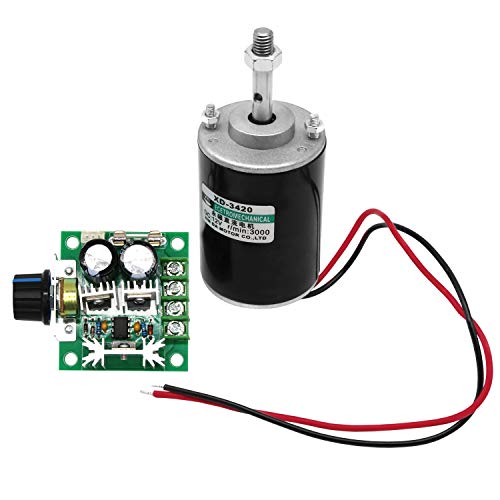
This motor features a high speed of 3000 RPM at 12V with CW/CCW capability and a robust 0.5A draw. It is explicitly marketed for DIY generators and similar mechanical setups, including small cotton candy machines and mini cutting benches. The integrated speed controller emphasizes efficiency, high torque, low heat, and reverse polarity protection, which can be valuable in learning projects and hobbyist builds where control precision matters.
Coliao Mini Generator Motors Pack

The Coliao bundle offers multiple small DC motors rated at 3V, 4.5V, and 12V with speeds ranging from 1500 to 6500 RPM. The motors have compact dimensions with a 24mm body diameter and about 0.87” height, making them ideal for micro wind turbine projects, STEM experiments, and educational kits. The line length of roughly 12–14 cm supports straightforward wiring in tight builds and experimentation arrays.
HUSETOO High Torque DC Motor

The HUSETOO motor is a 12V-24V, 30W unit designed for high torque output with CW/CCW rotation. A 43mm shaft length supports accessible gearing and pulley setups for DIY generators and small wind turbine projects. With a 0.5A current draw and ample torque (1 kgf·cm at 12V and 2 kgf·cm at 24V), this motor suits builds requiring steady torque under varying voltages, as well as installations that prioritize reliable mechanical performance in compact spaces.
Buying Guide: Key Purchase Considerations
- Voltage compatibility: Ensure the motor’s voltage range matches your power source or generator design. Some models operate at 3V–12V, while others sustain 12V–24V, affecting speed and torque.
- Speed vs. torque: Higher RPMs deliver more speed; higher torque supports heavier loads. For wind turbine generators, a balance that yields stable output at your wind conditions is essential.
- Mounting and shaft geometry: Check shaft diameter, length, and mounting holes to ensure compatibility with your hardware and gears, belts, or pulleys.
- Torque and current: Look at torque ratings and current (amps) to estimate energy conversion efficiency and how the motor interacts with a controller or regulator.
- Noise and cooling: Some motors run quietly, while others produce noticeable hum under load. Consider heat generation for longer-run applications and whether a heatsink or cooling is needed.
- Durability and form factor: Compact, rugged housings are preferable for educational kits and field experiments. The body dimensions influence enclosure design and mounting.
- Control features: For DIY generators, CW/CCW capability and compatibility with speed controllers can improve performance and safety during load changes.
- Cost vs. project scope: Balanced choice between performance and budget. A bundle offering multiple units can be useful for parallel testing or educational activities.
Performance Perspectives
- High-speed motors (e.g., 3500–7000 RPM at 12V/24V) provide rapid response in small generators but may require more careful voltage regulation to avoid overspeed under varying wind conditions.
- Mid-range torque motors are well-suited for steady, reliable output with modest load changes, making them a good fit for teaching labs and hobby projects.
- CW/CCW capable models simplify experimentation with generator configurations, allowing researchers and students to explore rotational direction effects on electrical output.
- Durability and ease of mounting are important for long-term experiments and in environments where equipment may be moved or reconfigured frequently.