
Investing in a robust 10 kW three-phase inverter can power larger equipment, solar-battery systems, and mixed loads with higher efficiency. This guide highlights five top options with around 10 kW capacity, detailing key features, compatibility, and what to consider when choosing. Each product below is evaluated for 3-phase capability, parallel operation, and suitability for grid-tied or off-grid setups.
| Product | Brand | Key Feature |
|---|---|---|
| 3 Pack ExpertPower 10KW Hybrid Solar Inverter | ExpertPower | 12KW PV input, 10KW AC output, parallel up to 60KW, built-in WiFi, 120/208/240V |
| PowMr 10KW Split Phase Hybrid Inverter | PowMr | 110/220V outputs, 6400W PV input, 120A MPPT, up to 30kW peak |
| SUNGOLDPOWER 10KW DC 48V Inverter | SGPWOSAY | UL1741, 2 MPPT, 200A charging, parallel up to 6 units, 120/240V |
| ZLPOWER 10KW Off-Grid Hybrid Inverter | NETSOLAR | 200A MPPT, batteryless option, parallel up to 6 units, 120/240V |
| LGIB Single Phase to 3 Phase Converter | LGIB | Plug-and-play 10HP to 3PH, 208-240V output, simple setup |
Note: The products listed vary in how they define 3-phase capabilities—some are true three-phase inverters with parallel expansion, others are converters or hybrid inverters that can support three-phase outputs in practical configurations. Always verify local code compliance and installation requirements with a licensed electrician before purchasing.
ExpertPower 10KW Hybrid Solar Inverter

Overview: The ExpertPower 10KW hybrid inverter combines solar charging with a robust AC output and parallel expansion. It uses two 6000W PV inputs and a 200A battery charger, designed for grid-tied and off-grid installations. Its dual MPPT controllers optimize energy harvesting from multiple solar arrays, while the 10KW pure sine wave inverter supports 120/208/240Vac. The unit can be expanded through parallel configurations to scale up system capacity in the future.
Key points: This model emphasizes flexibility for larger homes or cabins, with a 12KW solar input ceiling and substantial parallel-ready capacity up to 60KW. It remains suitable for both grid-tied operations and emergency blackouts, helping users lower energy costs while enabling continued operation of critical loads. The built-in WiFi aids monitoring and remote management, essential for off-site supervision.
PowMr 10KW Split Phase Hybrid Inverter

Overview: PowMr’s 10KW inverter delivers split-phase outputs (110V/220V) and features a built-in 120A MPPT controller. Its peak power can reach up to 30,000W, thanks to a larger toroidal transformer design. The device supports both solar charging and utility/ generator inputs, making it adaptable for varied energy systems. It can handle up to 6 units in parallel in some configurations, expanding overall capacity when needed.
Key points: The 48V battery integration and wide PV input range (up to 6400W) make this a strong candidate for mid-sized off-grid homes or workshops. It is suitable for high-demand appliances like refrigerators, pumps, and power tools, provided the system is correctly sized and balanced across phases. Consider ventilation and heat management in enclosed spaces to sustain performance.
SUNGOLDPOWER 10KW 48V Inverter

Overview: This all-in-one unit combines a 10KW DC input with dual MPPT controllers (up to 200A total charging). It supports split-phase (120V/240V) as well as parallel operation up to six units. It includes built-in WiFi for remote monitoring and an external app, enabling status tracking and parameter adjustments. It’s designed to be compatible with LiFePO4 and other battery chemistries.
Key points: The inverter offers multiple charging modes, including Solar Priority and Hybrid modes, to optimize energy usage. It also emphasizes protective features—over-voltage protection on PV input, battery protection, and overload protection—helping to safeguard the system under dynamic solar conditions. Ideal for owners seeking a flexible, expandable solar-storage solution with real-time monitoring.
ZLPOWER 10KW Off-Grid Hybrid Inverter
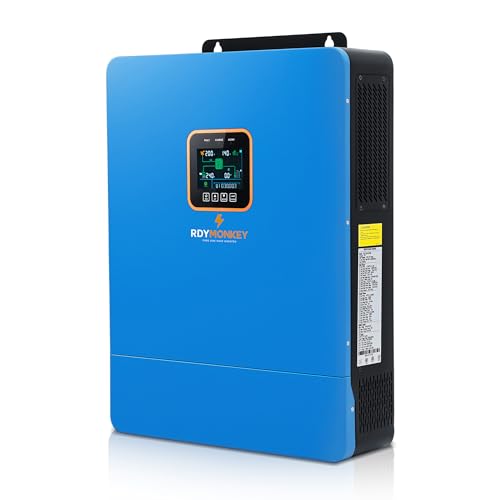
Overview: The ZLPOWER 10000W off-grid hybrid inverter provides 120V/240V split-phase compatibility and supports 200A MPPT charging. It is designed for battery-based or batteryless operation and can be paralleled with up to six units for higher total capacity. The input range accommodates a broad array of PV configurations, and the unit includes CAN/RS485/USB for smart communication and remote monitoring.
Key points: Battery flexibility and the option for batteryless operation offer value in retrofit installations or new builds. The dual MPPTs enable efficient solar harvesting from multiple arrays. Consider the space and ventilation required for multiple units in a larger solar storage system, as well as compliance with local electrical codes when stacking units.
LGIB Single Phase to 3 Phase Converter

Overview: This device is designed to convert single-phase input into three-phase output, effectively enabling a 10HP motor setup to run on 3-phase power. It’s particularly straightforward to install, with plug-and-play wiring and no complex programming required. It is suitable for residential and light commercial equipment expecting 220-240V three-phase power.
Key points: This converter provides a practical solution when you already have a single-phase source and need three-phase output for motors or machinery. It’s not a pure solar inverter, but it complements systems where existing motor loads require 3-phase power. Ensure compatibility with your motor load and consider the efficiency and cooling needs, especially under heavy, continuous operation.
QNK 7.5KW VFD Inverter (3-Phase Output)

Overview: This variable frequency drive converts input power to 3-phase output, with 7.5KW rated capacity and 0-33A current range. It supports 3-phase 220 VAC output, making it applicable for CNC spindles, spares, and similar equipment. It emphasizes low-noise operation and reduced EMI, plus MODBUS compatibility for advanced control scenarios.
Key points: While under the 10KW range, this option remains relevant for certain 3-phase demands within a broader system. It is especially useful for precision control requirements in CNC or motor-driven processes. Plan for cooling, proper enclosure, and protective measures to maintain reliability in continuous operation.
Buying Guide: Key Purchase Considerations For 10KW 3-Phase Inverters
- 3-Phase Capability And Parallel Expansion: Confirm whether the unit is true three-phase output and whether it supports paralleled configurations to scale capacity to meet higher loads or future growth.
- PV Input And Battery Compatibility: Look for multiple MPPT inputs, high PV input wattage, and compatibility with common battery chemistries (LiFePO4, lead-acid, etc.). Assess whether the system supports batteryless operation as a fallback.
- Output Voltage And Frequency: Ensure the inverter supports your local grid standard (120/208/240V) and 50/60 Hz operation. Verify suitability for sensitive equipment and motor loads.
- Hybrid vs. Pure Inverter: Hybrid units offer solar charging plus grid/utility interaction; pure inverters emphasize cleaner sine wave output but may require additional charging options. Choose based on how you plan to source energy (solar, grid, generator).
- Protection Features: Over-voltage, under-voltage, short-circuit, overload, and thermal protections are essential. Look for LCD or app-based monitoring for real-time status checks and alarms.
- Monitoring And Connectivity: Built-in WiFi or ethernet with mobile apps improves remote supervision and maintenance. Consider cloud-based dashboards if available.
- Physical Footprint And Cooling: Higher-power inverters generate heat; ensure adequate ventilation and space for installation in an electrical room, shed, or outdoor enclosure with weather protection.
- Compliance And Certification: UL1741 or other regional certifications indicate compliance with safety and reliability standards. Verify warranty terms and service options.
- Budget And Total System Cost: Include installation hardware, wiring, batteries, and potential parallel units. A larger system can reduce grid dependence but requires careful design to avoid imbalances.
Across these options, the best choice depends on system goals: whether you prioritize ease of installation with parallel scalability, or you need a specific output configuration for motor loads and CNC equipment. For solar-heavy residential setups, hybrids with dual MPPTs and strong charging capability offer the most flexibility, while phase converters provide practical upgrades for existing single-phase systems needing three-phase power.